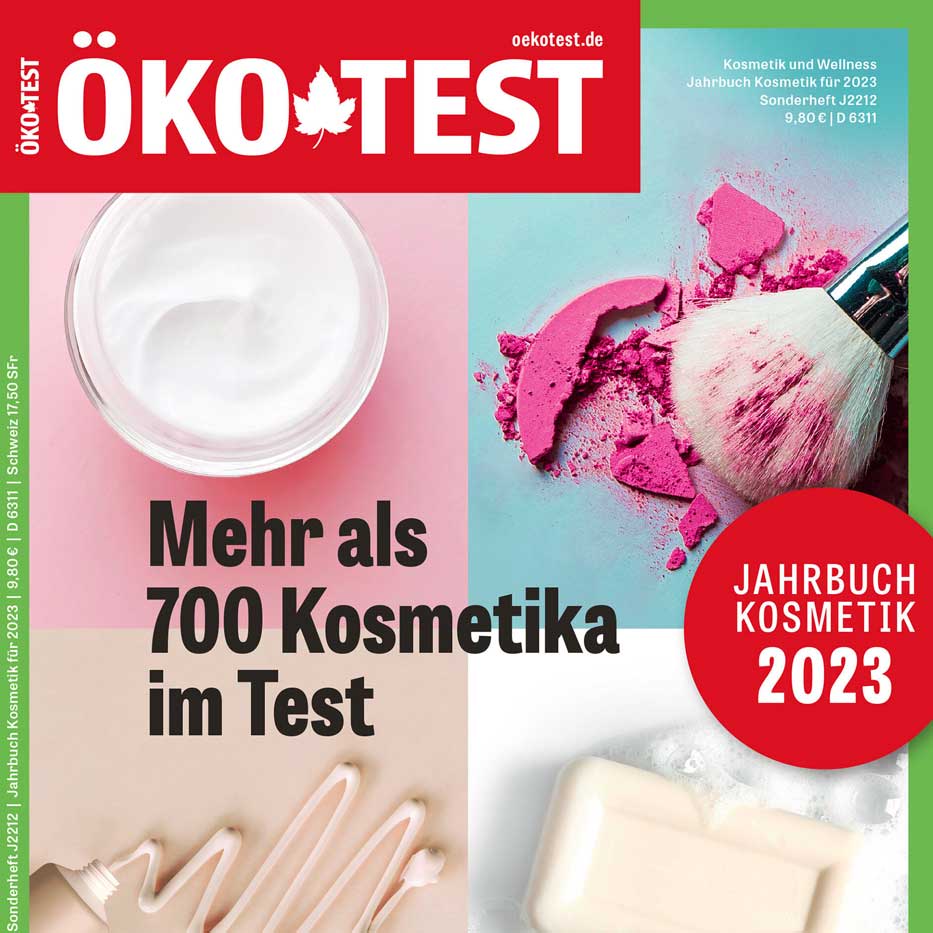
Raw materials developed and continuously produced by us were mentioned in combination with finished products in the 2023 yearbook of the magazine ÖKO-TEST®.
Source, image: Edition type: Digital; Edition name: J2212D; Release date: 08.12.2022.

Modal Title

Raw materials developed and continuously produced by us were mentioned in combination with finished products in the 2023 yearbook of the magazine ÖKO-TEST®.
Source, image: Edition type: Digital; Edition name: J2212D; Release date: 08.12.2022.
The Frankincense Powder Extract 10:1 (INCI: Boswellia Serrata, full name: Boswellia Serrata Resin Extract) is obtained from the resin of Boswellia serrata and supplied as a brown, free-flowing powder. Maltodextrin (1 to 20%) serves as the carrier; extraction is performed with ethanol and water. For formulators in the cosmetic and food industries, this extract is of particular interest due to its content of boswellic acids, which are listed as the primary marker in the CONIUNCTA® data sheet. The Resin as Starting Material Unlike many plant extracts derived from leaves, roots or fruits, this raw material is based on the resin of the frankincense tree. The botanical origin and manufacturing are in China. The extract ratio is 10:1; the composition comprises 80 to 99% frankincense extract and 1 to 20% maltodextrin as carrier. The colour is described as golden yellow to light brown; odour and colour are organoleptically characteristic. Boswellic Acids as Marker Compounds The extract is characterised by its boswellic acids. According to the CDS, boswellic acids (KBA + AKBA) are indicatively present at 70 to 350 mg/g in the product. 11-Keto-beta-boswellic acid (KBA) is specified individually at 1 to 3% and AKBA at 0.5 to 2% in the extract. These compounds are the analytically measurable reference parameters of this raw material. At a use level of 2% in a cosmetic formulation, the extract provides a calculated 1.4 to 7.0 mg/g boswellic acids in the finished formula. For functional food and beverages, the CDS states 0.88 to 4.4 mg/g boswellic acids in the formulation at a 1.3% use level. These figures facilitate the calculation of marker concentration across formula components. Documented Effects and Targets The CDS lists the claims "Anti-inflammatory" (basis: phytochemical profile and published literature) as well as "wound healing" and "firming" (basis: published literature) for the cosmetic sector. For the food sector, "Nutritional antioxidant, traditional dietary ingredient" as well as metabolic health and the reduction of oxidative stress are mentioned. NF-kB, collagen synthesis and the glucocorticoid receptor are documented as molecular targets. These statements are taken directly from the data sheet; the final promotional claims on the finished product are the responsibility of the person placing it on the market and must be verified under applicable cosmetic and food law. Powder Form and Technical Data In powder form, this extract offers advantages for dry applications and for formulations in which a defined marker content is to be set via the powder fraction. The particle size is 80 mesh, with at least 95% passage through 80 mesh (untamped). Bulk density is stated as 0.50 to 0.70. The recommended use concentration according to the CDS is 1 to 3% in cosmetics (general guideline 2 to 5%) and 0.5 to 2% in functional food and beverages. Product form: brown powder Extract ratio: 10:1 Plant part: resin (Boswellia serrata) Carrier: maltodextrin (1 to 20%) Shelf life: 24 months when stored dry between 10 and 30 degrees C in the original sealed container Safety, Storage and Documentation According to the SDS, the raw material is not a hazardous substance under Regulation (EC) No. 1272/2008 and is not a UN dangerous good. No PBT/vPvB properties and no endocrine disruptors (at or above 0.1%) were identified. The identified use is defined as a cosmetic and food raw material; the product is compliant with Regulation (EC) No. 1907/2006 (REACH). Storage in a cool, dry and well-ventilated location in airtight containers, away from heat and moisture, is recommended. The complete TDS, SDS and CDS are available via our technical documentation. Note: A temperature- and storage-time-dependent colour change cannot be excluded and does not constitute a quality defect. Sourcing and Portfolio Classification The Frankincense Powder Extract 10:1 complements our range of classic plant extracts with a resin-based powder concentrate featuring a clearly defined marker profile. An overview of the full product range is available in our product list. For sample requests, specifications and certificates of analysis, please contact our team. You can view the raw material here: View Frankincense Powder Extract 10:1 in the CONIUNCTA® Shop. CONIUNCTA® - Raw materials, data and services for future-ready formulations.
Read moreBlack Orchid Extract, with the INCI name Cycnoches Cooperi Extract, is a botanical extract derived from the orchid Cycnoches cooperi, intended exclusively for cosmetic formulations. CONIUNCTA® offers it as a liquid extract in three carrier variants: standardised in glycerin, in an Aqua/Propylene Glycol system, and in an Aqua/Pentylene Glycol system. As a conventional quality, the extract is aimed at formulators who wish to combine moisture-promoting and conditioning activity profiles with an exclusive orchid raw material. Cycnoches cooperi: an orchid as a cosmetic raw material The Black Orchid Cycnoches cooperi provides the source matrix for this extract. CONIUNCTA® uses a water-based extraction process to obtain the extract fraction, which is then transferred into the respective standardisation medium. The extract is of plant origin and suitable for vegan formulations. It can therefore be incorporated into concepts where a botanical character and a clear raw material origin are paramount. Glucomannan and other documented compounds The documented active constituents are centred on polysaccharides, in particular glucomannan. The CONIUNCTA® data sheet states an indicative content of 3.7 to 11 mg/mL; the literature content in the dried drug is given in the data sheet as 15 to 35 percent. In addition, phenanthrenes at levels of 0.01 to 0.1 percent have been described in several related orchid species. This polysaccharide fraction forms the analytical basis for the moisture-related properties of the extract. Documented activity profile for skincare The CDS lists several cosmetically relevant properties for Black Orchid Extract: moisturising, moisture-promoting, conditioning, astringent, balancing, elasticity support, and anti-ageing. The extract is therefore well suited to formulations aimed at moisture-focused and smoothing care. All statements refer to cosmetic applications in accordance with Regulation (EC) No 1223/2009. Three carrier variants for different systems The glycerin variant contains approx. 70 percent glycerin and approx. 30 percent extract fraction, and requires no glycol co-solvent. The Propylene Glycol variant is formulated as an Aqua/Propylene Glycol blend, and the Pentylene Glycol variant as an Aqua/Pentylene Glycol system (approx. 50 percent water, approx. 30 percent extract, approx. 20 percent Pentylene Glycol). Regardless of variant, the extract content is around 30 percent. This allows the most suitable carrier base to be matched to the existing formulation system. Specifications, usage and handling The extract appears as a clear to amber-coloured liquid (amber to light brown) with a density of 1.03 to 1.06. The recommended use concentration stated in the shop is 0.5 to 3 percent; the product-specific TDS specifies a range of 2 to 5 percent. Shelf life is 24 months when stored dry between 10 and 30 °C in the original sealed container. According to the SDS, the product is not classified as a hazardous substance under Regulation (EC) No 1272/2008. The extract is free from fragrance allergens subject to declaration under Annex III of Regulation (EC) 1223/2009 and is intended exclusively for the cosmetics industry, not for food use. Note: Depending on storage temperature, colour changes or turbidity may occur; filtration is possible in such cases and does not affect quality. Documentation and enquiry For a well-founded evaluation, CONIUNCTA® provides technical documentation (TDS, SDS and CDS); specific batch values for pH, relative density and refractive index can be found in the respective CoA. Black Orchid Extract and other botanical rarities are available in our Orchid Extracts collection. Those wishing to learn more about our extraction process will find further information on our AVE Technology page. A complete overview is also available in our product list. For samples, data and product-specific consultancy, please contact us: View Black Orchid Extract in the CONIUNCTA® shop. CONIUNCTA® – Raw materials, data and services for future-ready formulations.
Read moreThe Black Tea Powder Extract 10:1 (INCI: Camellia Sinensis) is a concentrated powder raw material derived from the tea plant, aimed at formulators in the cosmetic and food industries. As a powder form with a density of 0.50 to 0.70, the extract can be incorporated into both dry systems and aqueous preparations. The focus is on a clearly documented phytochemical profile featuring EGCG, caffeine, and total polyphenols, which forms the basis for antioxidant applications. EGCG as the Key Marker of the Black Tea Powder The primary marker of the extract is EGCG (Epigallocatechin gallate), a representative of the catechins from the class of flavan-3-ols. In the product, EGCG is present at an indicative concentration of 210 to 350 mg/g. This concentration makes the Black Tea Powder Extract a purposefully deployable carrier of a defined catechin profile that can be traced in incoming quality control and specification. In addition to EGCG, further compounds have been identified: caffeine in a range of 2 to 5 percent and total polyphenols of 15 to 30 percent. This combination characterises the 10:1 powder as a polyphenol-rich raw material with an additional caffeine component. Documented Effects for Cosmetics and Food The CONIUNCTA® data sheet lists astringent properties and antioxidant protection for the extract, each based on the phytochemical profile and published literature. For the food sector, an antioxidant effect is documented that supports lipid metabolism and cardiovascular function on the basis of literature. The data sheet names the following application targets: in the cosmetic context ROS, the Nrf2/ARE signalling pathway and MMPs; in the food sector ROS scavenging, inhibition of LDL oxidation and endothelial function. As a regulatory reference point in the food sector, the data sheet cites an EFSA reference value of 300 to 800 mg polyphenols per day from tea. The marketing keywords "antioxidant" and "invigorating" serve solely as thematic orientation; substantiated claims are based exclusively on the CDS. Use Concentrations and Product Form For cosmetic applications, the data sheet recommends a use level of 1 to 3 percent, with a generally recommended use level of 2 to 5 percent. In the food sector, for example for functional beverages and supplements, 1 to 3 percent is documented. The colour of the powder ranges from golden yellow to light brown; colour changes due to storage conditions or temperature are possible and do not affect the specification. Product form: Powder (10:1) Density: 0.50 to 0.70 Use concentration cosmetics: 1 to 3 percent (generally 2 to 5 percent) Use concentration food: 1 to 3 percent Suitability: all cosmetic and food variants Safety, Storage and Documentation According to Regulation (EC) No. 1272/2008, the Black Tea Powder Extract is not a hazardous substance and carries no hazard pictogram and no signal word. Transport is not subject to dangerous goods regulations (ADR/RID, IMDG, IATA). The safety data sheet complies with Regulation (EC) No. 1907/2006 (REACH); no PBT/vPvB status and no endocrine-disrupting properties have been identified. Storage conditions: keep container tightly closed, storage temperature 15 to 25 degrees C, storage class 13 (non-combustible solids). In the original sealed container under dry storage conditions between 10 and 30 degrees C, the shelf life is 24 months. The complete data sheets (TDS, SDS and CDS) are available to registered customers in the technical documentation. Background information on our manufacturing process can be found on the AVE Technology page. Portfolio Classification and Procurement The Black Tea Powder Extract 10:1 complements our range of classic plant extracts with a catechin- and polyphenol-rich raw material in powder form. For formulators who wish to incorporate a defined EGCG profile with caffeine and total polyphenols into cosmetic or food applications, the powder offers a flexibly dosed base. View the Black Tea Powder Extract in the CONIUNCTA® shop or contact us for technical enquiries regarding the specification. Our technical team provides individual consultation. CONIUNCTA® - Raw materials, data and services for future-ready formulations.
Read more