

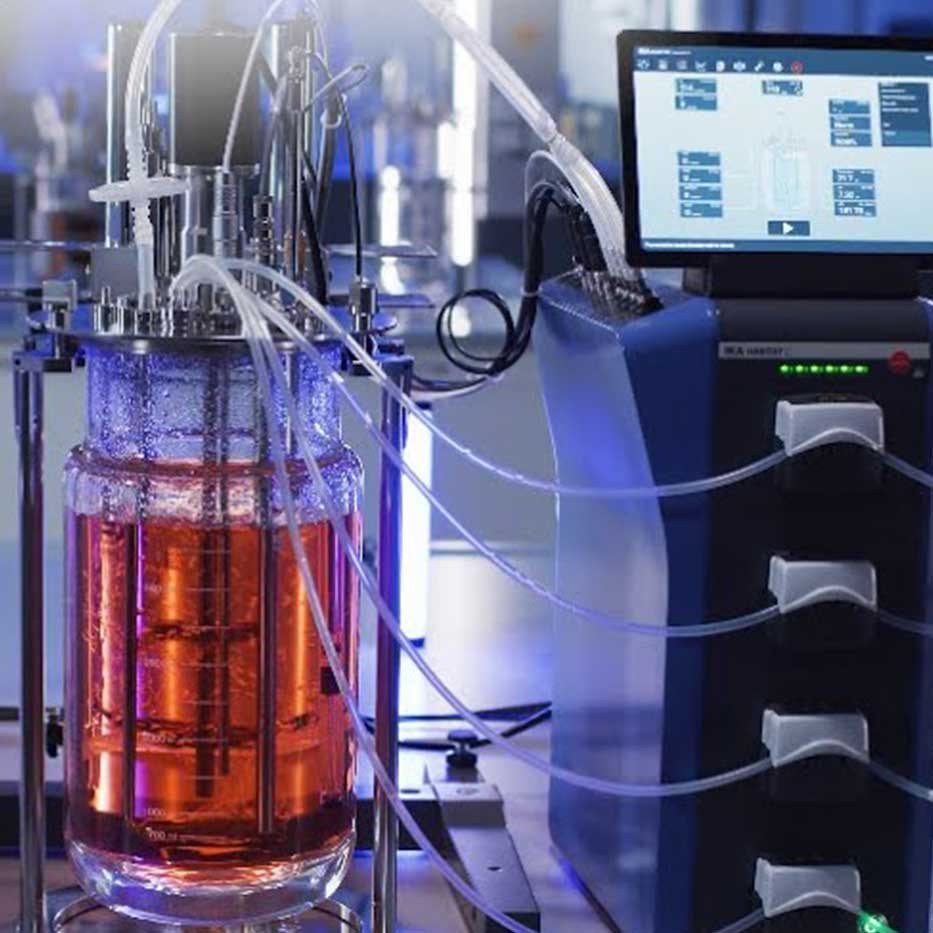
The IKA HABITAT® bioreactor expands CONIUNCTA® biotechnological processes for the production of innovative raw materials.
The IKA HABITAT® Bioreactor Expands Biotechnological Processes at CONIUNCTA® for the Production of Innovative Raw Materials
IKA® and CONIUNCTA® have further developed their processes for the production of innovative raw materials. These new technologies enable the manufacturing of raw materials that can be used in various industries, such as cosmetics and food processing.
Techniques such as fermentation and cell culture generate high-quality and sustainable raw materials. Stable processes ensure the purity and effectiveness of the products while contributing to environmentally friendly and resource-efficient production.
With these innovations, IKA® and CONIUNCTA® are setting new industry standards, offering their customers the opportunity to enhance their products with premium and sustainable raw materials. “Our new biotechnological processes represent a significant advancement and demonstrate our commitment to quality and sustainability,” says Adrian Klotz, CEO of CONIUNCTA®.
Angelica Root Extract (INCI: Angelica Archangelica Root Extract) is obtained from the root of Angelica archangelica. CONIUNCTA® offers it in three water-based carrier variants: with Glycerin, with Propylene Glycol, and with Pentylene Glycol. The product is of conventional quality and is intended primarily for the food industry. Relevant for formulators are the clearly defined lead marker and the regulatory framework derived from the furocoumarin content.
Chlorogenic Acid as Analytical Lead Marker
Chlorogenic acid is listed as the primary marker of the extract in the CDS. The indicative content in the product is 49 to 252 µg/mL; the literature content of the drug is stated as 0.2 to 0.8 % (ESCOP Monographs, 2nd). This defined marker enables analytical characterisation of batches and forms the basis for quality assurance. Regardless of the respective carrier variant, the extract content is approximately 30 %.
Imperatorin and the Furocoumarin Context
Imperatorin is also listed in the CDS as an active constituent, a furocoumarin for which no concentration data are provided. Due to the furocoumarin content, the extract is phototoxically relevant: the CDS explicitly refers to the required phototoxicity assessment in accordance with SCCS/1557/15. This regulatory note must be taken into account by the formulator in every application assessment.
Primarily a Raw Material for the Food Industry
This product is intended primarily for the food industry. Cosmetic use is only possible with restrictions, as the extract contains furocoumarins and is phototoxically relevant (see SCCS). For food suitability, the Glycerin variant is designated in the metafield. The suitability of the raw material for the respective application, use, and process must be assessed independently by the customer.
Carrier Variants and Composition
The three variants differ in their standardisation and carrier system:
Glycerin variant: INCI Glycerin, Angelica Archangelica Root Extract; Glycerin (≥ 99.5 %, anhydrous) approx. 70 %; extraction solvent purified water (not remaining in the final product).
Propylene Glycol variant: INCI Aqua, Propylene Glycol, Angelica Archangelica Root Extract; standardisation medium Propylene Glycol/water mixture.
Pentylene Glycol variant: INCI Aqua, Pentylene Glycol, Angelica Archangelica Root Extract; standardisation medium Pentylene Glycol/water.
All variants are clear liquids with a characteristic colour (amber to light brown), with a relative density of 1.03 to 1.06. The plant part used is the root of Angelica archangelica, of vegetable origin. As a reference: 1 kg of CONIUNCTA® extract contains the hydrophilic and lipophilic constituents of approx. 35 g of dried or approx. 220 g of fresh drug. Further water-based systems can be found in our overview of glycerin extracts.
Handling, Storage, and Stability
According to the SDS, the product is not a hazardous substance under Regulation (EC) No. 1272/2008 and is not a UN transport hazardous material. During processing, vapours and aerosols must not be inhaled; eye protection is required, skin protection is not. Storage should be dry, in the original sealed container; the stated shelf life is 24 months. Colour changes during the storage period as well as possible turbidity or precipitates may occur and have no effect on quality; filtration may be required if necessary.
Documentation and Ordering
For Angelica Root Extract, we provide the technical documents (TDS, SDS, CDS) as well as batch-specific certificates of analysis (CoA) via our technical documentation. Background information on our manufacturing process can be found on the page about AVE technology. You can review the three carrier variants of the product directly here: View Angelica Root Extract in the CONIUNCTA® shop. Our technical team is happy to advise on the individual assessment of the field of application and regulatory framework.
CONIUNCTA® – Raw materials, data, and services for future-proof formulations.
The Damiana Powder Extract 10:1 (INCI: Turnera Diffusa) is a concentrated botanical raw material derived from the whole plant. As a golden-yellow to light-brown powder with an extraction ratio of 10:1, it is aimed at formulators and product developers in the cosmetic and food industries who are looking for a flavonoid-containing plant extract in a stable, easily dosable powder form. For processing, an extract of ethanol and water as well as maltodextrin as a carrier are available.
Turnera diffusa as the botanical basis
Damiana (Turnera diffusa) is an aromatic shrub. For this extract, the whole plant (Whole Plant) is processed, which incorporates the broad phytochemical profile of the species into the concentrate. The starting material originates from China and is processed into a fine powder with a particle size of 80 mesh (minimum 95 percent through 80 mesh, untamped).
Flavonoids as lead markers
Analytically defining for the Damiana Powder Extract are flavonoids, in particular apigenin and acacetin. In the product, flavonoids are indicatively present at 7 to 45 mg/g, derived from 0.1 to 0.5 percent in the dried plant material, multiplied by the concentration factor 10:1 and a yield of 70 to 90 percent. Apigenin is documented in the starting material at 0.05 to 0.2 percent.
As further verified compounds, essential oil containing cineol (0.5 to 1 percent in the starting material) as well as arbutin as an analytically accessible marker are documented. No quantitative figure is available for arbutin.
Cosmetic activity profile according to CDS
For cosmetic application, the Damiana extract is classified as soothing, based on the phytochemical profile and published literature. The cosmetic targets documented include ROS scavenging, MMP inhibition and modulation of NF-kappaB. These details describe the activity profile stored in the CDS and serve as guidance for formulation development; they do not constitute a formulation recommendation.
The extract is suitable for all cosmetic variants and is eligible as a cosmetic raw material in accordance with Regulation (EC) No. 1223/2009. The CDS recommends a use level of 1 to 3 percent for cosmetics; the general product recommendation is 2 to 5 percent. At a use level of 2 percent, a calculated 0.14 to 0.90 mg/g of flavonoids is introduced into the formulation.
Use in functional foods
For the food sector, the Damiana Powder Extract is classified as a nutritional antioxidant and as a traditional dietary ingredient. The targets listed in the CDS include metabolic health and oxidative stress reduction. A use level of 0.5 to 2 percent is recommended in functional foods and beverages; at a use level of 1.3 percent, a calculated 0.09 to 0.56 mg/g of flavonoids results in the formulation. The product is suitable for all carrier variants in food applications and is vegan.
Processing, stability and documentation
The Damiana Powder Extract is a brown powder with a characteristic odour and taste and a density of 0.50 to 0.70. When stored dry between 10 and 30 degrees Celsius in the original sealed container, the shelf life is 24 months. A temperature- and storage-dependent change in colour cannot be excluded. According to the SDS, the powder is not a hazardous substance in accordance with Regulation (EC) No. 1272/2008 and is not a dangerous good for transport; vapours and aerosols should not be inhaled. We provide the complete data via our technical documentation (TDS/SDS/CDS).
Sourcing and further raw materials at CONIUNCTA®
The Damiana Powder Extract complements our portfolio of classic plant extracts with a flavonoid-containing raw material in powder form. Our overview of AVE technology provides additional information on our extraction processes. For project-specific requirements, our technical team is available for individual consultation. View Damiana Powder Extract 10:1 in the CONIUNCTA® shop.
CONIUNCTA® - Raw materials, data and services for future-ready formulations.
Malachite Extract (INCI: Malachite Extract, CAS 12069-69-1) is a mineral-derived raw material of vegetable origin that CONIUNCTA® offers in three carrier variants: Glycerin, Propylene Glycol, and Pentylene Glycol. All variants are clear liquids and designed as water-based systems. This provides formulators in the cosmetic and food industries with a hydrophilic extract of defined composition backed by a documented data set. This article places the marker, carrier systems, and application parameters in context based on the technical documentation.
Copper Carbonate as Qualitatively Confirmed Marker
The CDS lists copper carbonate (Cu₂CO₃(OH)₂) as the primary marker. The confirmation is qualitative; no concentration value is provided, and data confidence is classified as limited and semi-quantitative. No further specific compounds are documented in the data sheet. This transparent classification is essential for formulation planning, as CONIUNCTA® communicates exclusively what the data sheet confirms and does not indicate any standardizations beyond that.
Documented Properties in the CDS
The CDS lists three claims based on chemical profile or published literature: "Balancing", "Elasticity support", and "Detoxifying". These formulations provide the framework for cosmetically compliant claims in line with the data sheet. CONIUNCTA® recommends always aligning the specific labeling on the finished product with the applicable regulatory requirements (Regulation (EC) No. 1223/2009) and the intended use.
Three Carrier Variants for Different Systems
The choice of carrier system depends on the target system of the formulation. The variants differ in their composition:
Glycerin variant (INCI: Glycerin, Malachite Extract): Glycerin ≥ 99.5%, anhydrous, as the main component of the finished product; declared as suitable for food use.
Propylene Glycol variant (INCI: Aqua, Propylene Glycol, Malachite Extract): water approx. 40%, extract approx. 30%, propylene glycol approx. 30%.
Pentylene Glycol variant (INCI: Aqua, Pentylene Glycol, Malachite Extract): water approx. 50%, extract approx. 30%, Pentylene Glycol approx. 20%.
Regardless of the variant, the extract content is approximately 30%. All variants are water-based and suitable for cosmetic applications; the glycerin variant is additionally declared for use in the food sector. For details on our water-based systems, please visit the collection of Glycerin Extracts.
Physical Characteristics and Use Concentration
The extract has a density of 1.03 to 1.06, and its color ranges from amber to light brown. The recommended use concentration for cosmetic applications is 2 to 5%. No specific use concentration is indicated for the food sector; the glycerin carrier variant is declared as suitable for this purpose. Specific pH, density, and refractive index values are reported per batch in the CoA.
Storage, Handling, and Regulatory Status
When stored dry between 10 and 30 °C in the original sealed container, the shelf life is 24 months. According to the SDS, the product is not a hazardous substance under Regulation (EC) No. 1272/2008, not a UN dangerous good, and compliant with REACH (Regulation (EC) No. 1907/2006). It belongs to storage class 12 (non-flammable liquids). Eye protection and avoidance of aerosol formation are recommended; skin protection is not required according to the SDS. The extract is free of fragrance allergens subject to declaration requirements (Annex III, Regulation (EC) No. 1223/2009) and suitable for vegan formulations. Note: Temperature-induced color changes as well as turbidity or precipitation may occur; filtration is possible in such cases and does not affect quality.
Documentation and Sourcing for Formulators
CONIUNCTA® provides complete technical documentation for each variant. TDS, SDS, and CDS as well as the batch-specific certificate of analysis support raw material qualification and formulation development; an overview is available on our technical documentation page. Background on our manufacturing approach is described on the AVE Technology page. Formulators and purchasers can view Malachite Extract in the CONIUNCTA® shop and enquire about the appropriate carrier variant; our technical team provides individual advice on suitability for each application.
CONIUNCTA® - Raw materials, data, and services for future-ready formulations.