


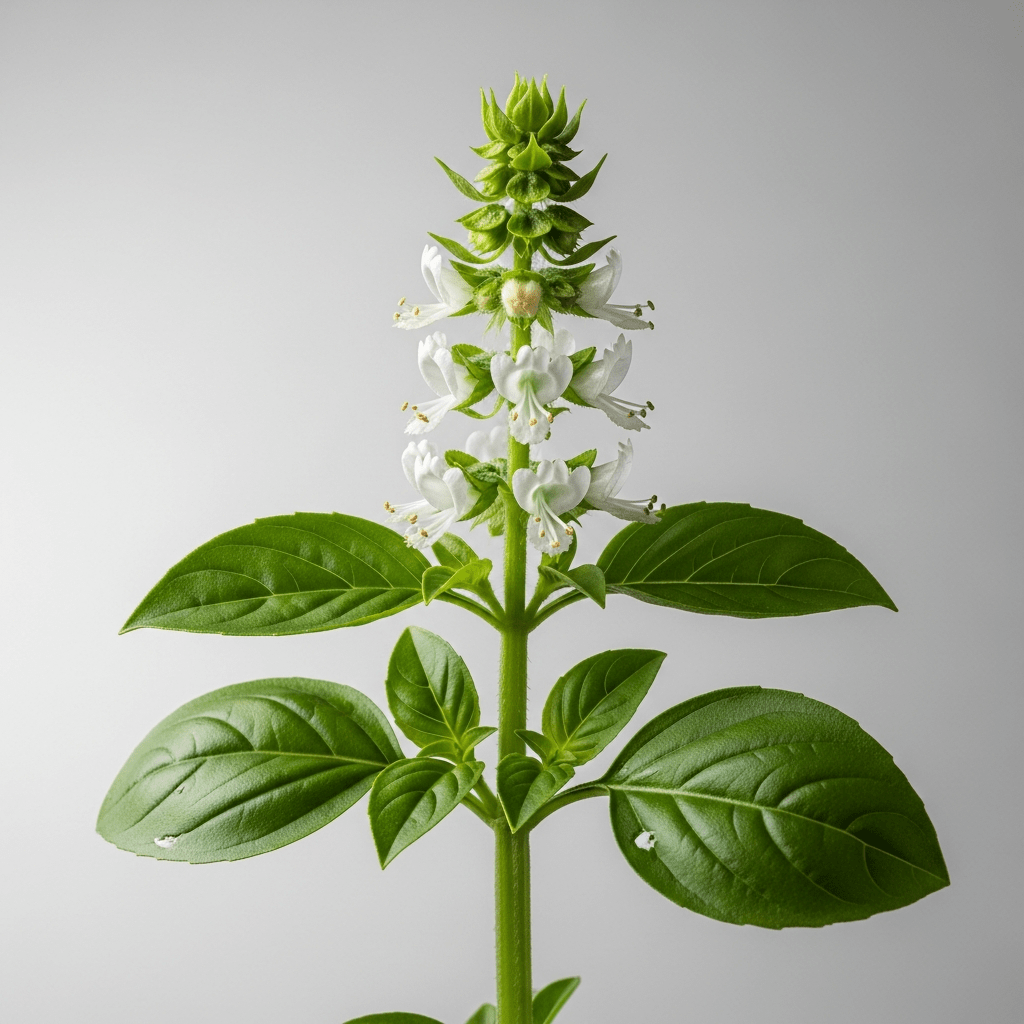
The Basil Extract (INCI: Ocimum Basilicum (Basil) Flower/Leaf/Stem Extract) from CONIUNCTA® is an aqueous-glycerin plant extract from the flower, leaf and stem of the basil plant. It is available in three carrier variants: Glycerin, Propylene Glycol and Pentylene Glycol. The extract is of conventional quality and designed as a liquid raw material for cosmetic and food applications. Of particular relevance for formulators is the documented marker compound rosmarinic acid, whose indicative content is quantified in the data sheet.
Rosmarinic Acid as the Marker Compound of Basil Extract
The Basil Extract is characterized via the primary marker rosmarinic acid. The CDS states a literature content of 0.5 to 2.5% for the dried plant (source: Lee & Scagel 2009). Using the drug-to-extract ratio (DER 1:10) and an assumed extraction efficiency of 70 to 90%, an indicative range of 122 to 788 µg/mL in the product results. At a cosmetic extract usage rate of 2%, this corresponds mathematically to 2.4 to 15.8 µg/mL in the finished formulation; at a 1.3% extract usage rate in food applications, to 1.5 to 9.9 µg/mL.
In addition to rosmarinic acid, the data sheet documents two further compounds: eugenol (volatile, 0.5 to 2%) and linalool (volatile). A note for formulation work: due to the aqueous, essential-oil-free extraction, the extract is free of fragrance allergens subject to declaration under Regulation (EC) No. 1223/2009, Annex III.
Documented Effects and Supported Claim Areas
The effects documented in the CDS for rosmarinic acid include soothing, anti-inflammatory and mild antimicrobial properties; in the food context, rosmarinic acid is described as a nutritional antioxidant and traditional dietary ingredient. As molecular targets, the data sheet names TRPV1 and COX-2 (cosmetics) as well as metabolic health and oxidative stress reduction (food).
Based on the phytochemical profile and published literature, the CDS lists the following supported cosmetic claim areas:
- Antioxidant protection
- Balancing
- Soothing
- Glow / radiance
- Pore-refining
- Skin-plumping
- Pro-age
These areas are to be understood as a documented claim basis from the data sheet. Suitability for a specific end application must be determined within the scope of the individual product development and compatibility testing.
What Is Basil Extract and What Is Behind It?
Basil, i.e. Basilikum, is the source plant of this extract. The terms "basil extract" and "basil extracts" as well as the Italian search variants "estratti naturali vegetali basilico" and "estratti naturali basilico" refer in principle to the same raw material: a plant extract from Ocimum Basilicum. In the case of the CONIUNCTA® product, this is provided as an aqueous-glycerin extract with an extract fraction of approx. 30% (CAS of the extract: 84775-71-3). The flower, leaf and stem (Flower/Leaf/Stem) of the plant of botanical origin are processed, which makes the extract suitable for vegan formulations.
Regarding the compositional data: regardless of the variant, the extract content is approx. 30%. One kilogram of CONIUNCTA® extract contains the hydrophilic or lipophilic constituents of approx. 35 g of dried or approx. 220 g of fresh source material.
Comparison of the Three Carrier Variants
The Basil Extract is available in three standardized carrier variants, which differ in composition and regulatory suitability:
- Glycerin variant: carrier system glycerin (anhydrous, ≥ 99.5%), making up approx. 70% of the final product; extract fraction 30%, extraction solvent purified water. According to the CDS, the glycerin carrier variant is suitable for food applications.
- Propylene glycol variant: INCI Aqua (Water), Propylene Glycol, Ocimum Basilicum (Basil) Flower/Leaf/Stem Extract; standardization medium is a propylene glycol/water mixture.
- Pentylene glycol variant: INCI Aqua, Pentylene Glycol, Ocimum Basilicum (Basil) Flower/Leaf/Stem Extract; composition approx. 50% water, approx. 30% extract, approx. 20% pentylene glycol.
According to the CDS, all variants are suitable for cosmetic applications; for food applications, the glycerin variant is designated. The recommended usage concentration is 2 to 5%; the


