


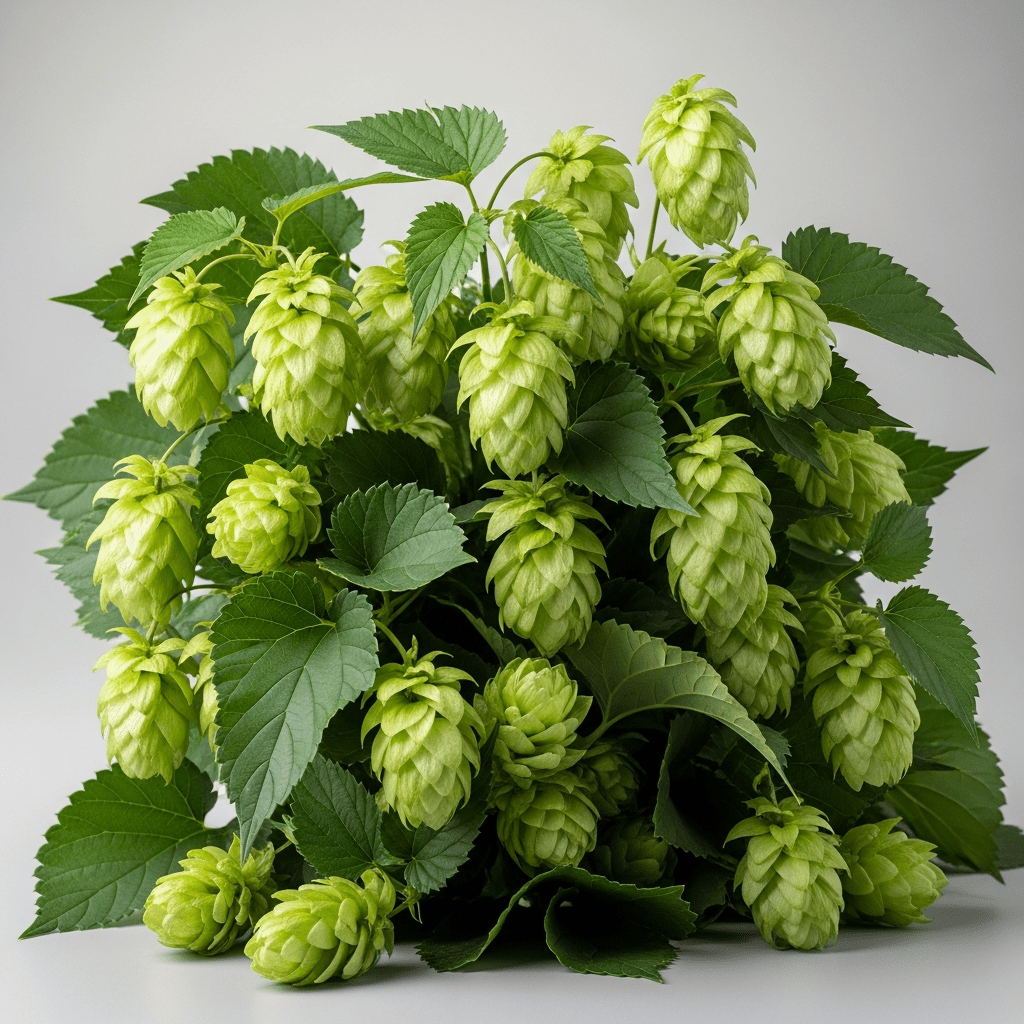
The Hop Powder Extract 10:1 with the INCI name Humulus Lupulus is a brown, powdered concentrate made from the whole plant. As a powder with an extract ratio of 10:1, it delivers the characteristic hop compounds in a dosable, easy to handle form. The product is suitable for cosmetics in accordance with Regulation (EC) No 1223/2009 as well as for food applications and is suitable for vegan formulations. For formulators seeking a concentrated plant-based raw material based on xanthohumol (often searched for in Spanish as extracto de lupulo or extracto de lúpulo), this extract combines a defined marker profile with the processability of a dry powder.
What is hop extract? (¿Que es extracto de lupulo?)
Hop extract is a plant-based concentrate derived from Humulus Lupulus. The CONIUNCTA® Hops Powder Extract is obtained from the whole plant using ethanol and water, and subsequently processed into a powder on a maltodextrin carrier. The composition consists of 80 to 99 percent hop extract and 1 to 20 percent maltodextrin. The extract ratio of 10:1 means that the characteristic constituents are concentrated relative to the source plant. The result is a brown powder with a characteristic odor and taste, with a particle size of 80 mesh (at least 95 percent pass-through).
Xanthohumol, 8-Prenylnaringenin and Humulon: the marker profile
The central marker of this extract is xanthohumol, a prenylated flavonoid found in hops. The indicative content in the product is 7 to 90 mg/g. This range is derived from the literature content in the dried plant (0.1 to 1 percent), the 10:1 concentration factor and a recovery rate of 70 to 90 percent. As a reference, the data sheet cites the Ph. Eur. with a minimum value of 0.35 percent total flavonoids, as well as Stevens & Page 2004.
In addition, the data sheet documents further compounds: 8-prenylnaringenin, a phytoestrogen, at 0.01 to 0.05 percent, as well as the alpha acids (humulones) at 2 to 12 percent. This means that this hop extract with humulon also covers the alpha acid fraction frequently sought after by formulators. The marker profile makes the extract a well-defined raw material whose parameters are traceable per batch in the certificate of analysis.
Documented activity profile in cosmetics and food
For cosmetic applications, xanthohumol is listed in the data sheet with the properties "Skin conditioning" and "antioxidant". "Soothing" is named as a supported claim area in cosmetics, with reference to the phytochemical profile and published literature. The cosmetic field of application is described as "General skin health".
For food applications, xanthohumol is documented as a "Nutritional antioxidant" and "traditional dietary ingredient". The application targets named in the data sheet for the food sector are "Metabolic health" and "oxidative stress reduction". These statements closely follow the data sheet and do not replace a product-specific regulatory assessment by the party placing the product on the market.
Use concentrations for formulators
For cosmetics, the data sheet states a generally recommended use concentration of 2 to 5 percent, while the "At-a-Glance" use level is 1 to 3 percent. At 2 percent extract usage, this calculates to a xanthohumol content of 0.14 to 1.8 mg/g in the finished formulation. For functional foods and beverages, a use level of 0.5 to 2 percent is stated; at 1.3 percent extract usage, this results in 0.09 to 1.1 mg/g xanthohumol in the formulation.
As a dry powder with a density of 0.50 to 0.70, the extract can be incorporated into powder and dry formulations, soluble beverage bases, as well as aqueous and emulsion-based systems. The specific solubility is not specified in the TDS; incorporation into the respective formulation matrix should therefore be verified as part of one's own development work.
Why a powder instead of a liquid variant?
The search for "hops powder" or "extracto lupulo" in powder form comes up regularly. Compared to a carrier-bound liquid variant, a dry extract offers practical advantages: more compact storage, high marker concentration per gram and flexible incorporation into dry systems such as capsules, tablets, instant beverages or powder-based skincare. The maltodextrin carrier stabilizes the powder and supports flowability at 80 mesh. When stored dry between 10 and 30 degrees Celsius in the original sealed container, the shelf life is 24 months. It should be noted that a color change may occur depending on temperature and storage time.
Safety, documentation and sourcing
According to the safety data sheet, the Hop Powder Extract is not a hazardous substance under Regulation (EC) No 1272/2008; no hazard pictogram, signal word or H/P statements are required. The product is not classified as dangerous goods under ADR/RID, IMDG and IATA. Endocrine-active constituents pursuant to REACH Art. 57(f) or Regulations (EU) 2017/2100 and 2018/605 are not present at a concentration of 0.1 percent or above. Recommended storage temperature per the SDS: 15 to 25 degrees Celsius, container tightly closed.
For every raw material, we provide the technical documentation (TDS, SDS, CDS) as well as batch-specific certificates of analysis via our technical documentation. You can find further plant-based concentrates in our classic plant extracts, and an overview of our manufacturing process is provided by the AVE technology. You can review and inquire about the raw material discussed here directly: View Hop Powder Extract 10:1 (Humulus Lupulus) in the CONIUNCTA® shop.
CONIUNCTA® – Raw materials, data and services for future-ready formulations.


