


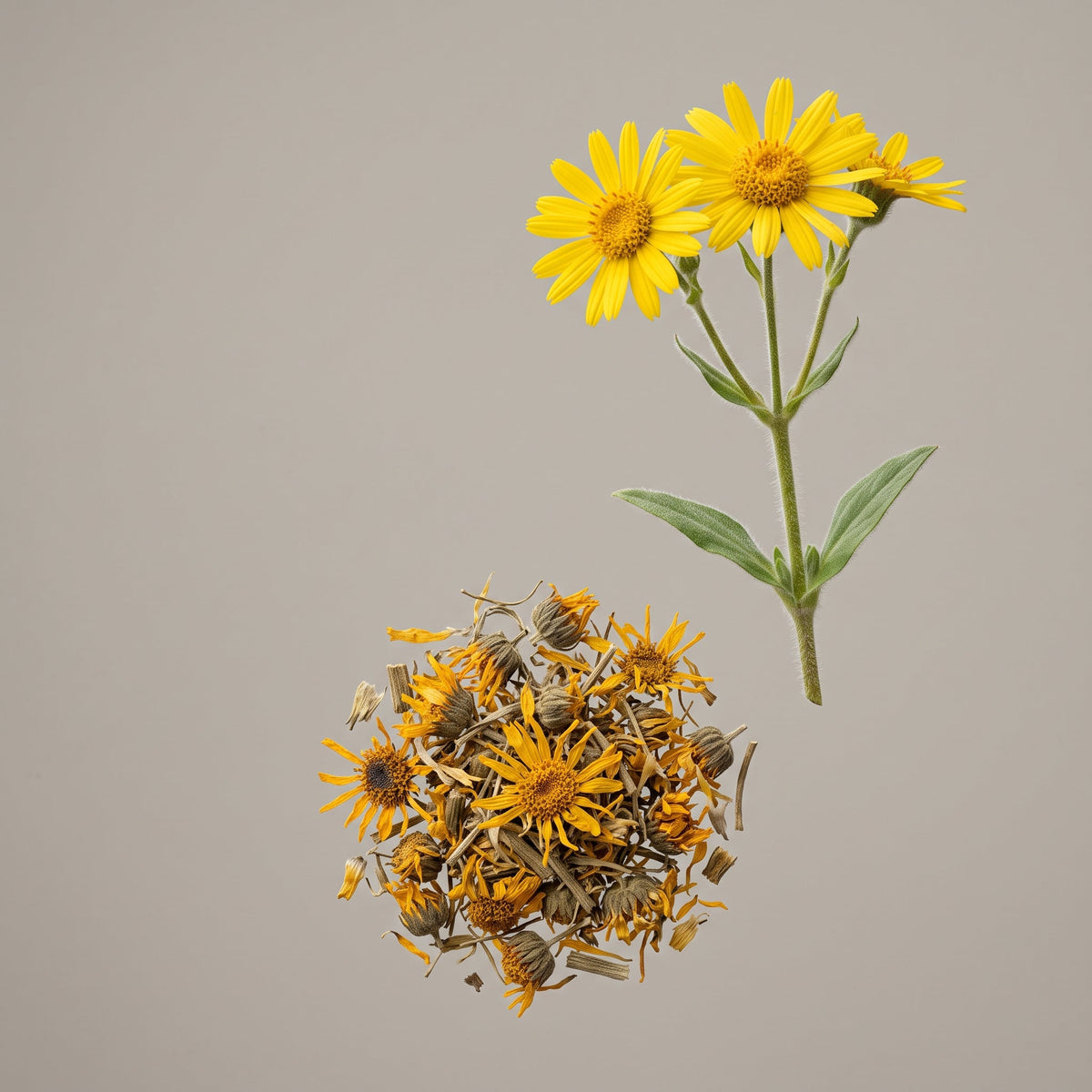
Arnica Extract (INCI: Arnica Montana Flower Extract) is obtained by CONIUNCTA® from the flowers of Arnica montana and is available as a liquid preparation in three carrier variants: based on glycerin, based on a propylene glycol/water mixture, and based on a pentylene glycol/water mixture. In all variants, the extract content is approximately 30%. The extract is intended exclusively for the cosmetics industry and is not suitable for food use. For formulators, the flower extract is of particular interest due to its documented marker profile centered on helenalin derivatives, chlorogenic acid, and flavonoids.
Helenalin Derivatives as an Analytical Lead Marker
Sesquiterpene lactones are characteristic of Arnica montana, foremost among them the helenalin derivatives (sesquiterpene lactone glycosides). In the CONIUNCTA® Arnica Extract, these are specified at a calculated 105 to 270 µg/mL in the product. At a use level of 3.5%, this corresponds to a calculated 3.7 to 9.5 µg/mL in the finished formulation. According to the Ph. Eur. (10th edition), the literature content in the dried plant is 0.5 to 1%. Helenalin is regarded in the datasheet as a well-documented marker; NF-κB and IKK-β are cited as mechanistic background (without constituting a product claim). Important for the use decision: the CDS explicitly points to a sensitization potential of helenalin at higher concentrations, which must be taken into account when selecting the concentration and assessing the safety of the finished product.
Further Documented Compounds
In addition to the sesquiterpene lactones, the datasheet documents further accompanying substances of the flower extract:
- Chlorogenic acid: 0.5 to 1%
- Flavonoids: 0.4 to 0.6%, additionally described as a characteristic qualitative component
- Polysaccharides: characteristic component (qualitative)
The flavonoids are attributed antioxidant and UV-protective properties in the datasheet, while the polysaccharides are attributed moisturizing and film-forming properties. These statements relate to the respective substance groups according to the CDS and must be independently substantiated by the finished product manufacturer in the context of the specific formulation.
Documented Efficacy Profile and Claim Areas
The datasheet attributes anti-irritating and soothing properties to the helenalin derivatives. As supported cosmetic claim areas, the CDS names: Balancing, Soothing / anti-irritant, Moisture-promoting, Pore-refining, and Skin-plumping. These claim areas serve as a starting point for positioning but require independent substantiation by the manufacturer of the finished product in accordance with Regulation (EC) No. 655/2013. The extract is suitable for vegan formulations and is classified as a cosmetic ingredient under Regulation (EC) No. 1223/2009; the safety assessment is carried out by the responsible person of the finished product.
Comparing the Three Carrier Variants
The choice of carrier system depends on the formulation architecture and the desired secondary profile:
- Glycerin variant (INCI: Glycerin, Arnica Montana Flower Extract): the standardization medium is glycerin at approximately 70% share of the final product, with approximately 30% extract. This involves water-based extraction followed by standardization in anhydrous glycerin. This variant is listed in our glycerin extracts.
- Propylene glycol variant (INCI: Aqua (Water), Propylene Glycol, Arnica Montana Flower Extract): a propylene glycol/water mixture serves as the standardization medium.
- Pentylene glycol variant (INCI preparation: Aqua (Water), Pentylene Glycol, Arnica Montana Flower Extract): a pentylene glycol/water mixture serves as the carrier system.
All three variants are present as a clear liquid with characteristic color (pale yellow, density 1.03 to 1.06) and are suitable for all cosmetic applications. The datasheet specifies a use concentration of 2 to 5%; for allergen calculation, a use level of 5% is on file. Our technical team is available to clarify specific formulation and dosage questions within this framework.
Processing, Storage, and Safety
Arnica Extract has a shelf life of 24 months when stored dry between 10 and 30 °C in its original sealed container; the safety data sheet additionally recommends a storage temperature of 15 to 25 °C and classification in storage class 12 (non-combustible liquids). Color changes may occur during storage depending on temperature; in the event of turbidity or precipitation, filtration is possible without impairing product quality. The extract is not classified as a hazardous substance under CLP (Regulation (EC) No. 1272/2008), is not PBT/vPvB, and is not subject to transport hazard regulations. It contains no endocrine-active substances within the meaning of the relevant regulations (≥ 0.1%) and is not placed on the market as a biocidal product.
Technical Documentation and Inquiries
For formulation work, TDS, SDS, and CDS are available for each carrier variant. Details on our gentle extraction process can be found on the page about AVE technology, and the complete datasheets in the technical documentation. Further botanical raw materials for soothing and moisture-promoting concepts can be found in our classic plant extracts. You can check out the raw material discussed here directly: View Arnica Extract in the CONIUNCTA® shop. Our technical team will be happy to advise you on samples, specifications, and the selection of the right carrier variant.
CONIUNCTA® – Raw materials, data, and services for future-proof formulations.


