


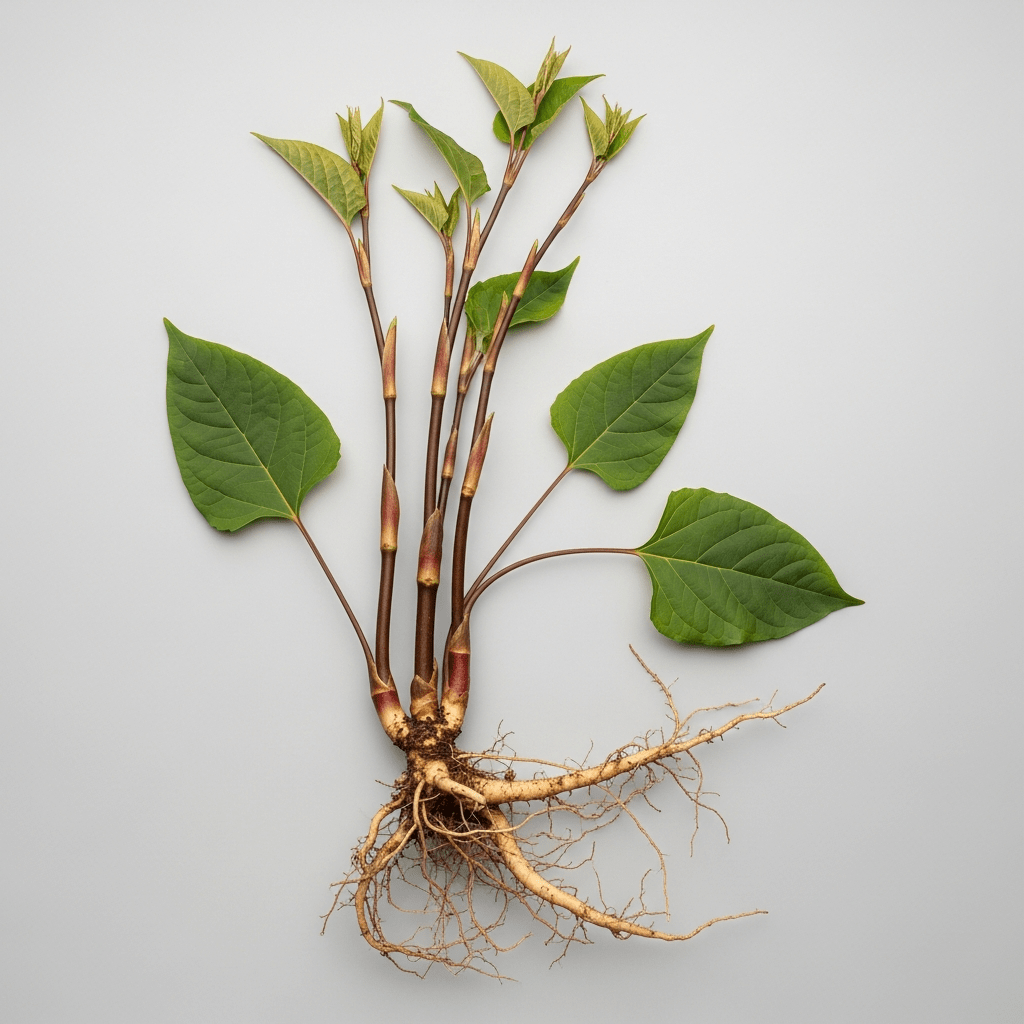
Japanese Knotweed (INCI: Polygonum Cuspidatum) is one of the most significant plant-based sources of trans-resveratrol. CONIUNCTA® offers this raw material as a powder extract at a ratio of 10:1: a golden-yellow to light-brown powder suitable for both cosmetic and food-grade applications. Of particular interest to formulators is the well-defined phytochemical profile, with resveratrol as the primary marker compound, complemented by additional stilbenes and anthraquinones.
Resveratrol as the Central Marker Compound
The documented resveratrol content in the product is indicatively 7 to 45 mg/g (trans-resveratrol). This is based on a drug concentration of 0.1 to 0.5 % (literature basis: Burns et al. 2002), which is enriched in the powder extract through a concentration factor of 10:1 and an extraction yield of 70 to 90 %. At a use level of 2 %, the extract delivers 0.14 to 0.90 mg/g resveratrol in the finished formulation. This range allows for transparent calculation of the marker content within a formulation.
Additional Documented Compounds
In addition to resveratrol, the extract contains further documented accompanying substances. In the crude drug, polydatin (resveratrol glucoside) at 1 to 4 % and emodin (anthraquinone) at 0.5 to 2 % are documented. This stilbene and anthraquinone profile characterises Japanese Knotweed as a phytochemically multifaceted raw material. The data sheet lists SIRT1, NF-kB and tyrosinase as molecular targets.
Documented Activity Profile
The data sheet describes antioxidant protection as well as an anti-inflammatory profile, each based on the phytochemical profile and published literature. For resveratrol, antioxidant properties, an anti-aging association and sirtuin activation are additionally documented. In the food context, the extract is classified as a nutritive antioxidant and traditional food ingredient. All statements are to be understood strictly in reference to the data sheet; suitability testing for the respective application is the responsibility of the processor.
Specification and Processing
The powder extract is obtained using ethanol and water and standardised on maltodextrin as a carrier (1 to 20 %). The INCI designation is Polygonum Cuspidatum Root Extract; the botanical origin is Polygonum Cuspidatum, with China as the country of origin, and the whole plant is processed. Key specifications:
- Extract ratio: 10:1
- Appearance: brown powder, colour golden-yellow to light-brown
- Particle size: 80 mesh (>= 95 % pass-through)
- Loss on drying: <= 5.0 %; total ash: <= 5.0 %
- Density: 0.50 to 0.70
- suitable for vegans
From a safety perspective, the powder is not a hazardous substance under Regulation (EC) No. 1272/2008 and is not a UN dangerous good. In the event of aerosol formation, respiratory and eye protection are required.
Use Concentration and Application Areas
For cosmetic applications, a concentration of 1 to 3 % is recommended (general range 2 to 5 %), regulated under Regulation (EC) No. 1223/2009. In the food sector, 0.5 to 2 % is recommended in functional foods and beverages; at a use level of 1.3 %, this results in 0.09 to 0.56 mg/g resveratrol in the formulation. As a powder, the raw material can be integrated into both aqueous and powder-based systems. CONIUNCTA® does not provide formulation recommendations; our technical team is available for individual consultation on how to incorporate it into your application. View Japanese Knotweed Powder Extract 10:1 in the CONIUNCTA® shop.
Storage, Documentation and Sourcing
When stored dry between 10 and 30 degrees C in the original sealed container, the shelf life is 24 months. Temperature-dependent colour changes during storage cannot be excluded and do not affect the specification. Complete data sheets (TDS, SDS, CDS) and certificates of analysis are available via our technical documentation. Further botanical raw materials can be found in our classic plant extracts and in the complete product list.
CONIUNCTA® - Raw materials, data and services for future-ready formulations.


