


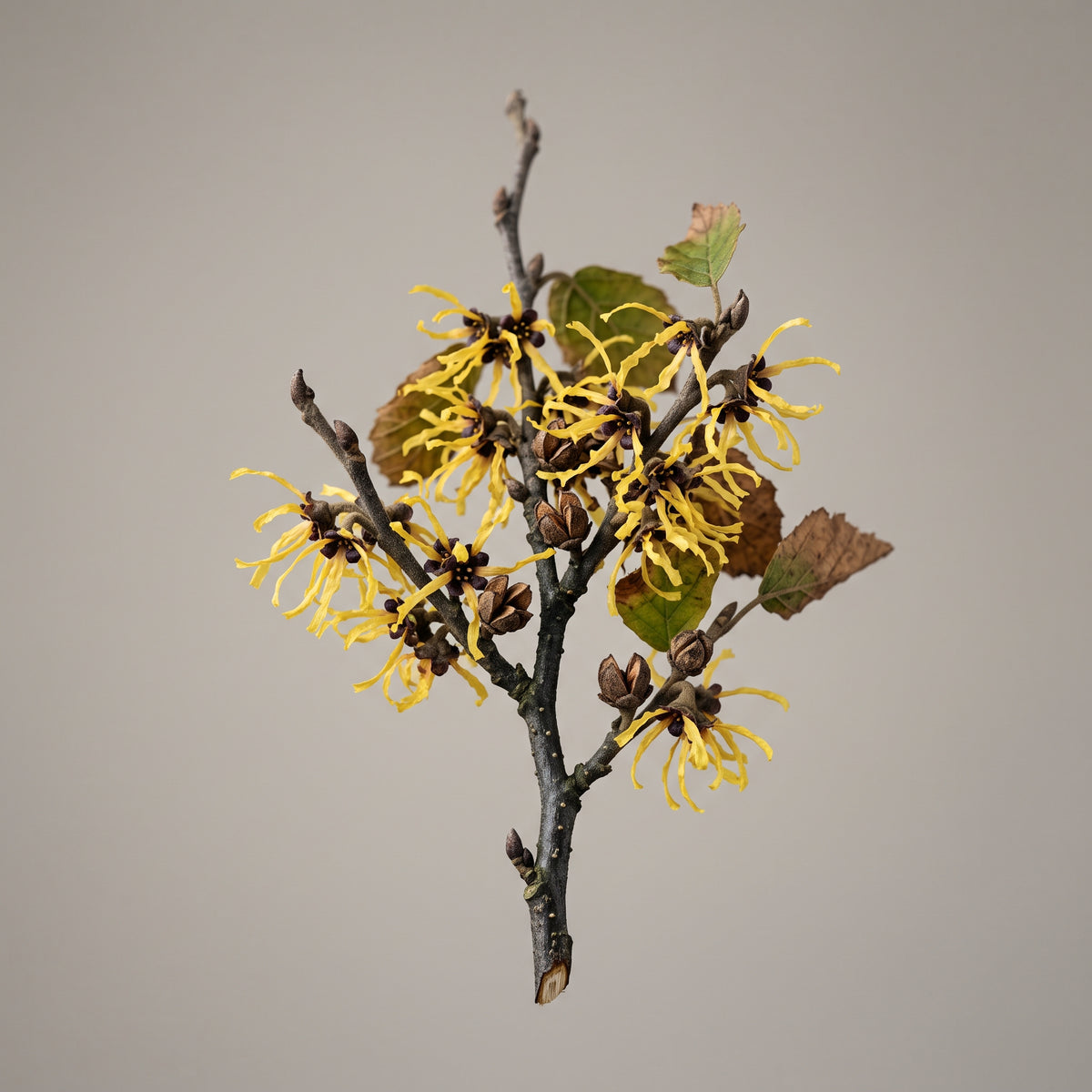
The Witch Hazel Flower Extract from CONIUNCTA® is an aqueous extract from the flowers of Hamamelis virginiana and is listed under the INCI Hamamelis Virginiana (Witch Hazel) Flower Water (EU INCI: Hamamelis Virginiana Flower Water). Purified water serves as the extraction solvent; the extract is available in three hydrophilic carrier systems: glycerin, propylene glycol and pentylene glycol. The extract is offered in conventional quality. For formulators, it is of particular interest because of its marker profile: the CDS lists hydrolysable tannins, with hamamelitannin as the species-specific lead compound, as the primary marker and documents an astringent, antioxidant and pore-refining effect for cosmetics. In this article, we classify markers, claim areas, carrier variants and handling data so that development and purchasing teams can make a well-founded preselection.
Hamamelitannin and total tannins: the marker profile of the witch hazel flower
The CDS names total tannins, calculated as hamamelitannin or pyrogallol, from the compound class of hydrolysable tannins as the primary marker. One detail is crucial for specification work: this is a qualitative marker. The CDS explicitly states no content („No content is calculated for this marker“); the data basis relies on pharmacopoeia or peer-reviewed data. Hamamelitannin itself is listed as the species-specific lead compound and is therefore the substance that characterises the profile of this extract.
In addition to the tannins, the CDS documents further compounds: gallic acid, for which the data sheet specifies a range of 0.5 to 2 %, as well as proanthocyanidins. Flavonoids, tannins and anthocyanins are listed as characteristic compound classes. The CDS also names protein precipitation and MMP-1 inhibition as mechanistic background. Both statements are explicitly marked in the data sheet as background information and do not constitute a product claim; we therefore reproduce them solely for technical context.
From tannin to claim: what the CDS documents for cosmetics
The documented cosmetic effect in the CDS reads verbatim „Astringent, antioxidant, pore-refining“. At the level of compound classes, the data sheet assigns an astringent function to the tannins and an antioxidant function to the flavonoids and anthocyanins; anthocyanins are additionally described as „colour-active“. These assignments refer to the compound classes and are not equivalent to an efficacy statement about the finished product.
Section 4 of the CDS also lists the supported claim areas Astringent, Balancing, Moisture-promoting, Glow / radiance, Pore-refining and Skin-plumping. One detail is relevant for claim strategy: „Skin-plumping“ appears only in Section 4, not in the summary in Section 7. Substantiation of every claim in the finished product is the responsibility of the responsible person in accordance with Art. 20 of Regulation (EC) No 1223/2009 and Regulation (EU) No 655/2013. The CDS claim areas thus provide a documented starting point but do not replace your own substantiation for the finished formulation.
Glycerin, propylene glycol or pentylene glycol: three aqueous extracts compared
All three variants share the aqueous extract from the flower and an extract content of approx. 30 %. According to product information, 1 kg of CONIUNCTA® extract contains the hydrophilic constituents of approx. 30 g of dried plant parts. For cosmetics, all three TDS state a use concentration of 2 to 5 %. Differences exist in the carrier system, the INCI declaration and food suitability:
- Glycerin: approx. 70 % anhydrous glycerin (≥ 99.5 %) and approx. 30 % extract. EU INCI: Glycerin, Hamamelis Virginiana Flower Water. Suitable for cosmetics and, as the only variant, also for food.
- Propylene glycol: aqueous-glycolic system of approx. 40 % water, approx. 30 % extract and approx. 30 % propylene glycol. EU INCI: Aqua, Propylene Glycol, Hamamelis Virginiana Flower Water. For cosmetics only.
- Pentylene glycol: aqueous-glycolic system of approx. 50 % water, approx. 30 % extract and approx. 20 % pentylene glycol. EU INCI: Aqua, Pentylene Glycol, Hamamelis Virginiana Flower Water. For cosmetics.
Three questions are therefore key to the selection: Which INCI list should the finished product carry, what water content fits the overall concept, and is a food application planned? The glycerin variant introduces no additional water via the carrier system and declares only glycerin alongside the extract. You can find further extracts on this carrier in our collection of glycerin extracts. Our technical team will address specific formulation and dosage questions individually.
Food and food supplements: why only the glycerin variant is an option
For food applications, only the glycerin carrier variant is food-grade; according to the TDS, the propylene glycol variant is explicitly not applicable for food. The CDS describes the effect in the food sector as „Traditional dietary ingredient“. For functional foods and beverages, the TDS of the glycerin variant cites a use concentration of 0.5 to 2 % from the literature.
The classification of the end product under food law and the assessment of its suitability for the respective application are the responsibility of the manufacturer of the finished product. The SDS confirms its status as a cosmetic raw material under Regulation (EC) No 1223/2009 and likewise limits food use to the glycerin variant.
Colour, storage and safety data in practice
The extract is liquid, and its colour is specified as amber to light brown. Temperature-dependent colour changes may occur during storage. Should turbidity or precipitation occur, filtration of the product is required; according to product information, this does not affect quality. pH value and relative density are not stated in the TDS but in the CoA, as density is maintained as an article-specific target value per carrier variant. Shelf life is 24 months when stored dry between 10 and 30 °C in the original sealed container.
For safety assessment, the CDS provides a useful value: at a use level of 5 %, fragrance allergens according to Annex III amount to a maximum of 0.75 mg/kg, against a leave-on limit of 10 mg/kg. This is a calculated, not a measured value. In addition, according to the CDS, the extract is suitable for vegan formulations. The SDS shows no classification under CLP (Regulation (EC) No 1272/2008), meaning no pictograms, no signal word and no H or P statements. All carrier variants are classified as WGK 1 (slightly hazardous to water), are not considered dangerous goods under ADR/RID, IMDG and IATA, and fall into storage class 12 according to TRGS 510. REACH registration is not required, as the extract is exempt under Annex V No. 8. As personal protective equipment, the SDS specifies safety glasses according to EN 166; skin protection is not required.
Documentation, quality status and sourcing
For the Witch Hazel Flower Extract, TDS, SDS and CDS are available for each carrier variant; batch values such as pH and density are documented in the respective CoA. An overview of access to these documents can be found on our page on technical documentation (TDS/SDS/CDS). The extract is available in conventional quality. For projects requiring a certified organic raw material, CONIUNCTA® offers a separate range certified according to Regulation (EU) 2018/848; you can recognise these products by the name prefix „BIO“.
Further plant extracts from our portfolio can be found in the collection Classic Plant Extracts. Our technical team will answer questions on carrier selection, specification or claim documentation at info@coniuncta.com or by phone at +49 911 47715370. You can find all carrier variants and data sheets for the product directly here: View Witch Hazel Flower Extract in the CONIUNCTA® shop.
CONIUNCTA®: raw materials, data and services for future-proof formulations.


