


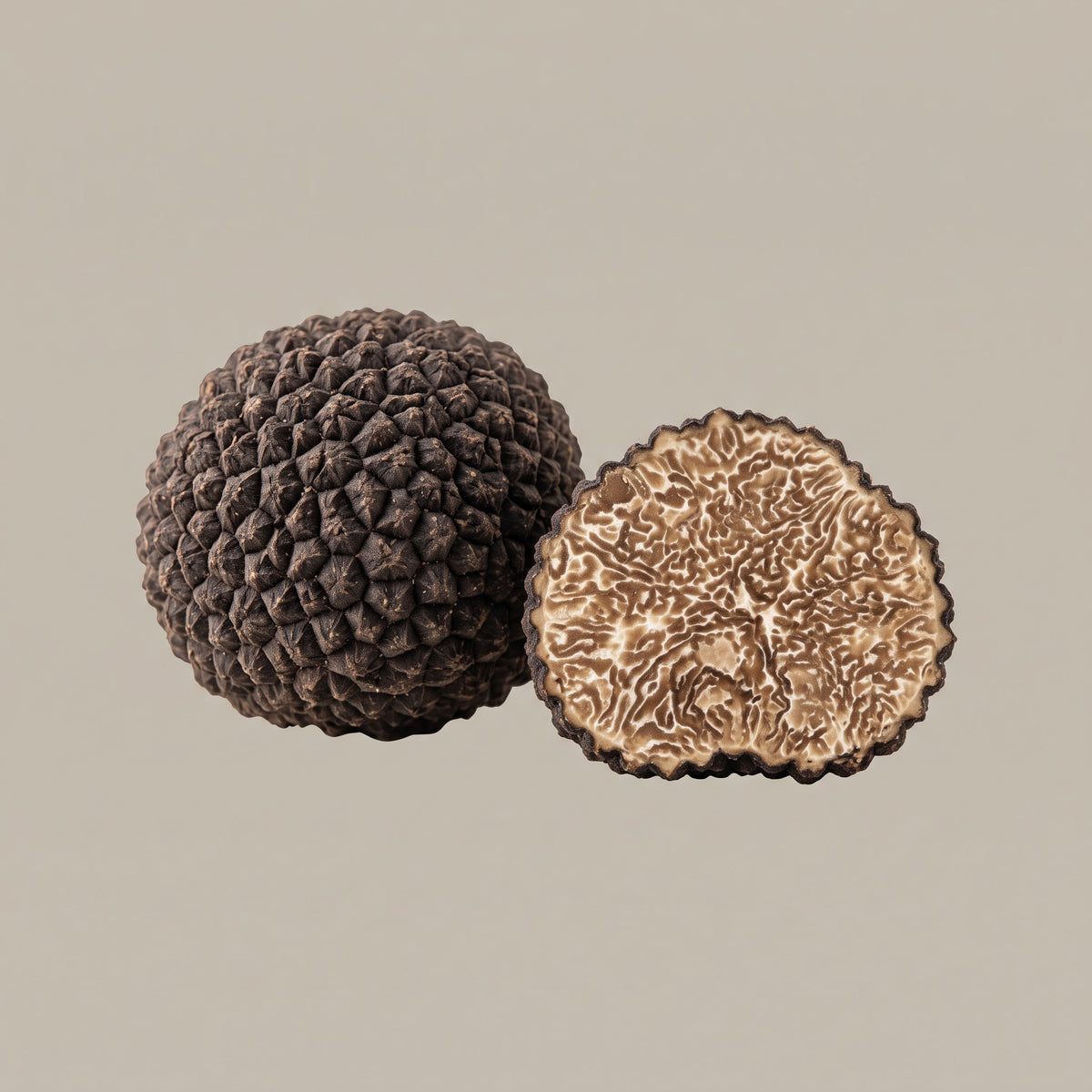
With the CONIUNCTA® PRO CPO-51 Truffle Oil Extract (INCI: Tuber Aestivum (Truffle) Extract), our premium line expands its portfolio with a raw material derived from the fruiting body of the summer truffle. The extract is presented as an anhydrous, oil-based preparation and is available in three lipophilic carrier variants: sunflower oil, jojoba oil, and squalane. The extract content is approximately 30% in each variant. For formulators working on oil-based anti-aging and elasticity concepts, the extract combines a defined fungal marker with integration into exclusively oily systems.
Ergosterol as a Defined Lead Marker of the Fruiting Body
The characteristic marker of this extract is Ergosterol, a fungal sterol marker of the summer truffle. In the product, the ergosterol content is calculated at 63 to 270 µg/mL; the literature content in the dried plant is reported at 0.3 to 1%, with additional documentation at 0.5 to 2%. Ergosterol serves in this extract both as an analytical identity marker and as a reference point for the documented active ingredient level. In addition, the data sheet describes a characteristic amino and volatile compound profile of the summer truffle, typical of Tuber Aestivum.
Documented Efficacy Profile at the Active Ingredient Level
At the active ingredient level of ergosterol, cosmetically antioxidant, UV-absorbing, and anti-tyrosinase properties are documented. As mechanistic background (not as a product claim), the data sheet cites ROS scavenging, tyrosinase, and MMP-1 as target structures. This mechanistic information describes the marker's mode of action and does not replace independent substantiation on the finished product.
Regulatorily supported claim areas for cosmetics include anti-aging, elasticity support, and skin-plumping. These claims require independent substantiation in accordance with Regulation (EC) No 655/2013. As a pure raw material, the extract is incorporated into a finished product, whose claims must be substantiated by the responsible person. CONIUNCTA® provides the technical documentation as a basis for this, not ready-made finished product claims.
Three Oil Carriers: Sunflower Oil, Jojoba Oil, and Squalane
The extract is consistently provided in oily systems, with the carrier also serving as the extraction and standardization medium. All three variants are formulated anhydrously (no water added) and consist of approximately 70% carrier oil and 30% extract content:
- Sunflower Oil (INCI: Helianthus Annuus (Sunflower) Seed Oil, Tuber Aestivum (Truffle) Extract): the broadly applicable, neutral carrier oil. Only this variant is additionally food-grade.
- Jojoba Oil (INCI: Simmondsia Chinensis (Jojoba) Seed Oil, Tuber Aestivum (Truffle) Extract): a skin-affine wax ester system for oil-based care formulations.
- Squalane (INCI: Squalane, Tuber Aestivum (Truffle) Extract): a lightweight, oxidation-stable hydrocarbon carrier for sensorially demanding concepts.
All variants appear as a clear liquid with characteristic color (amber to light brown). Suitability for cosmetic use is given for all three carrier variants. The relative density and refractive index can be found in the respective CoA. Our technical team is available to clarify specific formulation and carrier selection questions individually.
Use Concentration and Application Areas
For cosmetic application, a use concentration of 2 to 5% is documented. Since the extract is anhydrous and oil-based, it is suitable for the oil phase of emulsions as well as for water-free oily systems. For the food-grade sunflower oil variant, the literature cites a range of 0.5 to 2% in functional foods and beverages; the sunflower oil variant is documented as a traditional dietary ingredient. The squalane and jojoba oil variants are not food-grade and are intended exclusively for cosmetic applications.
Regarding allergen labeling: fragrance allergens subject to declaration under Annex III fall below the labeling threshold at the recommended use concentration. For limonene, a maximum value of 0.6 mg/kg is calculated at 5% use, against a threshold of 10 mg/kg. Allergen labeling of the finished product is the responsibility of the respective manufacturer. The formulation is vegan-suitable.
Safety, Storage, and Documentation
According to the safety data sheet, the mixture is not a hazardous substance and is not classified under Regulation (EC) No 1272/2008 (CLP); no hazard pictogram and no signal word are assigned. REACH is not applicable to the mixture; the botanical extract is exempt under Annex V, entry 8. The extract is not a biocidal product and does not claim biocidal action. In terms of handling, we recommend eye protection; vapors and aerosols should not be inhaled, and skin and eye contact should be avoided. Shelf life is 24 months when stored dry between 10 and 30 °C in the original sealed container. Possible color changes, cloudiness, or precipitation during storage do not affect quality; filtration may be sufficient if needed.
The complete data sets for all three carrier variants (TDS, SDS, CDS) are available via our technical documentation. Background on our gentle manufacturing process can be found on the page about AVE technology.
Sourcing and Advice for Formulators
The truffle oil extract is part of the premium line CONIUNCTA® PRO. Further lipophilic raw materials for oil phases can be found in our category of sunflower oil extracts. Our technical team is available for sample requests, specifications, and selecting the right carrier variant. View CONIUNCTA® PRO CPO-51 Truffle Oil Extract in the CONIUNCTA® shop.
CONIUNCTA® - Raw materials, data, and services for future-ready formulations.


