


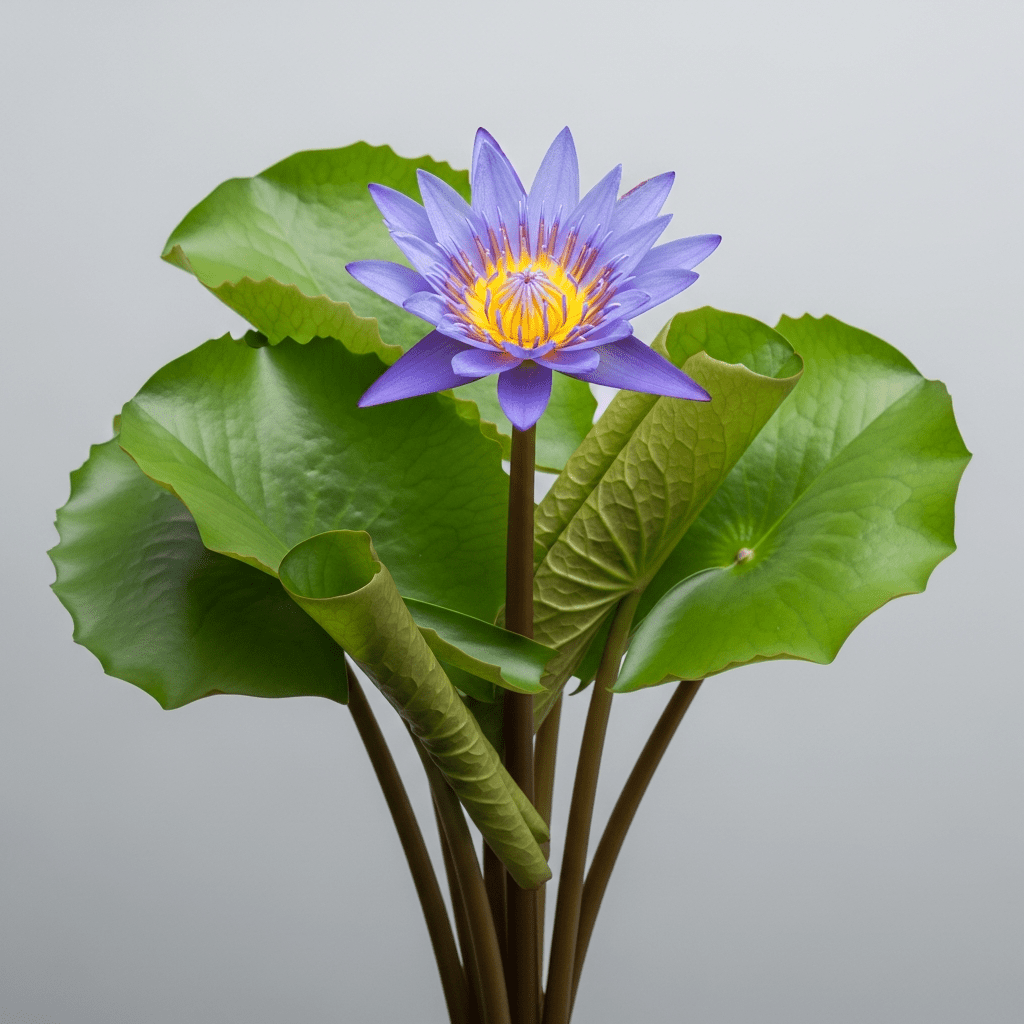
Blue Lotus Extract (INCI: Nymphaea Caerulea Flower Extract) is obtained at CONIUNCTA® from the flower of the Blue Lotus (Nymphaea caerulea). As a raw material for formulators, it is available in three water-based carrier variants: with Glycerin, with Propylene Glycol, and with Pentylene Glycol. The extract is supplied in conventional quality as a clear liquid with a characteristic color (amber to light brown). Its profile is defined by flavonol glycosides, making it interesting for antioxidant and soothing-oriented formulations.
Nymphaea caerulea: The Flower as Starting Material
The exclusive starting material is the flower of the Blue Lotus (Nymphaea caerulea), of plant origin. The extract fraction in the final product is approximately 30 percent. One kilogram of the extract contains the hydrophilic or lipophilic constituents of around 35 g of dried, or approximately 220 g of fresh, plant material. The drug-to-extract ratio (DER) of the extract fraction is 1:10 (dried); relative to the total product, this results in a DER of 1:33.3 (dried) for the Glycerin variant.
Flavonol Glycosides: The Documented Markers
The analytical profile of Blue Lotus Extract is dominated by flavonol glycosides. Myricetin and kaempferol glycosides are documented as primary markers, with an indicative content of 74 to 315 µg/mL in the product (corresponding to 0.3 to 1 percent in the dried plant material, source: Fossen & Andersen 1999, Phytochemistry). Additionally, quercetin glycosides and generally abundant flavonol glycosides have been detected. Trace amounts of nuciferine and nuphar alkaloids are also present.
These specifications originate from the CONIUNCTA® CDS. The exact batch-specific values (pH, relative density, refractive index) are stated in the respective Certificate of Analysis (CoA).
Documented Efficacy Profile for Cosmetics
For cosmetic use, the following effects are documented according to the CDS: antioxidant protection, balancing, soothing, elasticity support, moisture-promoting, and conditioning. As described points of action, the data sheet mentions, among others, ROS scavenging and MMP inhibition.
These statements are to be understood as cosmetically compliant contributions to a correspondingly oriented formulation. We do not derive any effects beyond those substantiated in the data sheet, nor any medical claims. Responsible evaluation and labeling of the finished product are the responsibility of the formulator.
Three Water-Based Carrier Variants Compared
Blue Lotus Extract is available in three carrier systems, all based on purified water as the extraction medium, differing in the standardization medium:
- Glycerin Variant (INCI: Glycerin, Nymphaea Caerulea Flower Extract): Glycerin (≥ 99.5%, anhydrous) makes up 70 percent of the final product. A classic aqueous-glycerinic preparation.
- Propylene Glycol Variant (INCI: Aqua, Propylene Glycol, Nymphaea Caerulea Flower Extract): an aqueous-glycolic preparation with Propylene Glycol/water as the standardization medium.
- Pentylene Glycol Variant (INCI: Aqua, Pentylene Glycol, Nymphaea Caerulea Flower Extract): a Pentylene Glycol/water mixture as the standardization medium.
All variants are suitable for cosmetic use and contain the extract fraction of approximately 30 percent. Selection depends on the carrier system of the target formulation and the desired interaction with other ingredients. Both the Glycerin-based and glycol-based variants integrate well into water-based systems. Further extracts on this basis can be found in our category of Glycerin extracts as well as in the overview of classic plant extracts.
Blue Lotus Extract, Extracto de Loto Azul, Loto Blu: One Raw Material, Multiple Names
Blue Lotus is searched for internationally under numerous names, including blue lotus extract, extracto de loto azul, and loto blu. Botanically, it is always the same species: Nymphaea caerulea. For unambiguous identification in a B2B context, the INCI designation Nymphaea Caerulea Flower Extract is authoritative, listed in combination with the respective carrier ingredient in the product title.
Processing Using AVE Technology
Production takes place via CONIUNCTA® AVE Technology (Adaptive Vacuum Extraction). The process comprises vacuum-assisted high-shear homogenization, cell disruption, controlled heat treatment, fine filtration, and standardized dilution. Details on the process are described on our AVE Technology page.
Can the Extract Also Be Used in Food?
For cosmetic use, the data sheet recommends a concentration of 2 to 5 percent. For the food sector, the following applies: Nymphaea caerulea is subject to the Novel Food Regulation (EU Regulation 2015/2283); use in food requires corresponding approval. The CDS mentions concentrations of 0.5 to 2 percent in functional foods and beverages in the food context. Regulatory review and implementation are the responsibility of the user.
Handling, Storage, and Documentation
According to the safety data sheet, the extract is not a hazardous substance under Regulation (EC) No. 1272/2008; no hazard pictogram or signal word is required. It is not classified as dangerous goods under ADR/RID, IMDG, and IATA and falls under storage class 12 (non-combustible liquids). Shelf life is 24 months when stored dry between 10 and 30 °C in the original sealed container. A possible change in color, turbidity, or precipitation during storage does not affect quality; filtration may be carried out if necessary. The complete TDS, SDS, and CDS, as well as the batch-specific CoA, are provided via our technical documentation.
Request Blue Lotus Extract
Our technical team is available for sample requests, data sheets, and clarification of project-specific requirements. Suitability for a specific application is determined by the customer at their own responsibility. Take a look at the Blue Lotus Extract in the CONIUNCTA® shop or contact us directly at info@coniuncta.com.
CONIUNCTA® – Raw materials, data, and services for future-proof formulations.


