


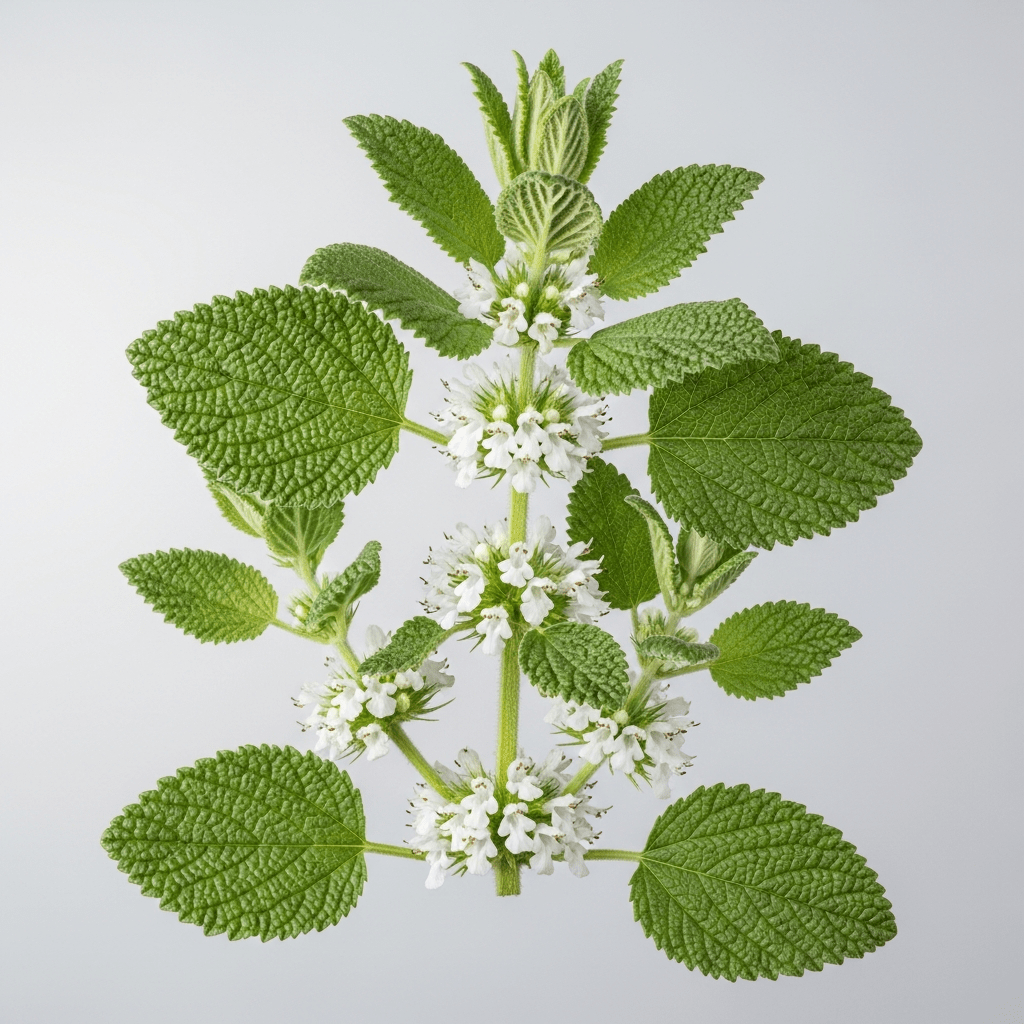
Horehound Extract (INCI: Marrubium Vulgare Extract) is obtained from white horehound (Marrubium vulgare), a member of the Lamiaceae family with characteristically grey-green hairy leaves. CONIUNCTA® offers this extract as a liquid product in three carrier variants: Glycerin, Propylene Glycol and Pentylene Glycol. This makes it possible to incorporate the ingredient into both cosmetic applications and, in the Glycerin variant, food-grade applications. For formulators, the phenylethanoid-rich profile is of particular interest and is discussed below on the basis of the available documentation.
Acteoside (Verbascoside) as Analytical Lead Marker
In the CDS, acteoside (verbascoside), a phenylethanoid glycoside, is recorded as the primary marker of this extract. The indicative concentration in the product is 74 to 315 µg/mL; the literature content in the dried plant is stated as 0.3 to 1 %. At a usage level of 2 % in the finished formulation, this yields a calculated acteoside content of 1.5 to 6.3 µg/mL. These figures serve for analytical characterisation and batch control and are useful for specification definition in product development.
Marrubiin is listed in the dossier as a further active compound, however without a concentration value. The applicable individual values for pH, density and refractive index are reported on a batch-specific basis in the Certificate of Analysis (CoA).
Documented Profile for Cosmetic Formulations
Based on the phytochemical profile and published literature, the CDS lists the following properties for cosmetic use: astringent, balancing, as well as Glow/Radiance and Skin-plumping. For marrubiin, the targets NF-kB and Phospholipase A2 as well as a reference to the skin barrier are recorded in the dossier. These details are drawn from the underlying documentation and must be evaluated in accordance with applicable cosmetic regulations (Regulation (EC) No 1223/2009).
The extract is declared as suitable for vegans and, according to the CDS, free from fragrance allergens subject to declaration requirements under Annex III of Regulation (EC) No 1223/2009. The recommended usage concentration stated in the product data sheet is 2 to 5 %, while the claim data are based on a range of 1 to 3 %.
Three Carrier Variants for Different System Requirements
The choice of carrier influences integration into the respective formulation system. The variants differ in their composition as follows:
- Glycerin (INCI: Glycerin, Marrubium Vulgare Extract): Glycerin (>= 99.5 %, anhydrous) as carrier at approximately 70 %; extraction solvent is purified water. This variant is also suitable for food/functional food applications.
- Propylene Glycol (INCI: Aqua, Propylene Glycol, Marrubium Vulgare Extract): Indicative values: water approximately 40 %, extract approximately 30 %, propylene glycol approximately 30 %.
- Pentylene Glycol (INCI: Aqua, Pentylene Glycol, Marrubium Vulgare Extract): Indicative values: water approximately 50 %, extract approximately 30 %, Pentylene Glycol approximately 20 %.
The extract content is approximately 30 % regardless of variant. All variants are described as clear liquids with a characteristic colour; the colour is stated as amber to light brown, and density as 1.03 to 1.06.
Use in Functional Food and Beverages
The Glycerin carrier variant is intended for food applications. The CDS specifies a usage concentration of 0.5 to 2 % in functional food and beverages. At a usage level of 1.3 %, calculated acteoside levels of 0.93 to 3.9 µg/mL result in the formulation. In the food context, the dossier records the aspects of nutritional antioxidant and traditional dietary ingredient with reference to metabolic health and oxidative stress. This classification must be assessed by the user in accordance with applicable food law provisions.
Specification, Storage and Safety Profile
According to the SDS, horehound extract is not a hazardous substance under Regulation (EC) No 1272/2008 and is not a dangerous good (ADR/RID, IMDG, IATA). The product is described as water-soluble with a pH range of 4 to 8; it exhibits no PBT/vPvB properties and no endocrine-disrupting properties (>= 0.1 %). Shelf life is 24 months when stored dry between 10 and 30 °C in the original sealed container. According to the disclaimer, possible colour changes, turbidity or precipitation during storage do not affect product quality; filtration is sufficient if required. All specifications are documented in the data sheets and in the batch-specific CoA, available via our technical documentation.
Purchasing and Further Information
Horehound Extract is part of our range of classic plant extracts and is available as a Glycerin variant within our glycerin-based extracts. Formulators and buyers can find all carrier variants and the associated data sheets directly in the shop: View Horehound Extract in the CONIUNCTA® Shop. For questions regarding characterisation or the selection of the appropriate carrier variant, our technical team is available for individual consultation.
CONIUNCTA® - Ingredients, Data and Services for Future-Ready Formulations.


