


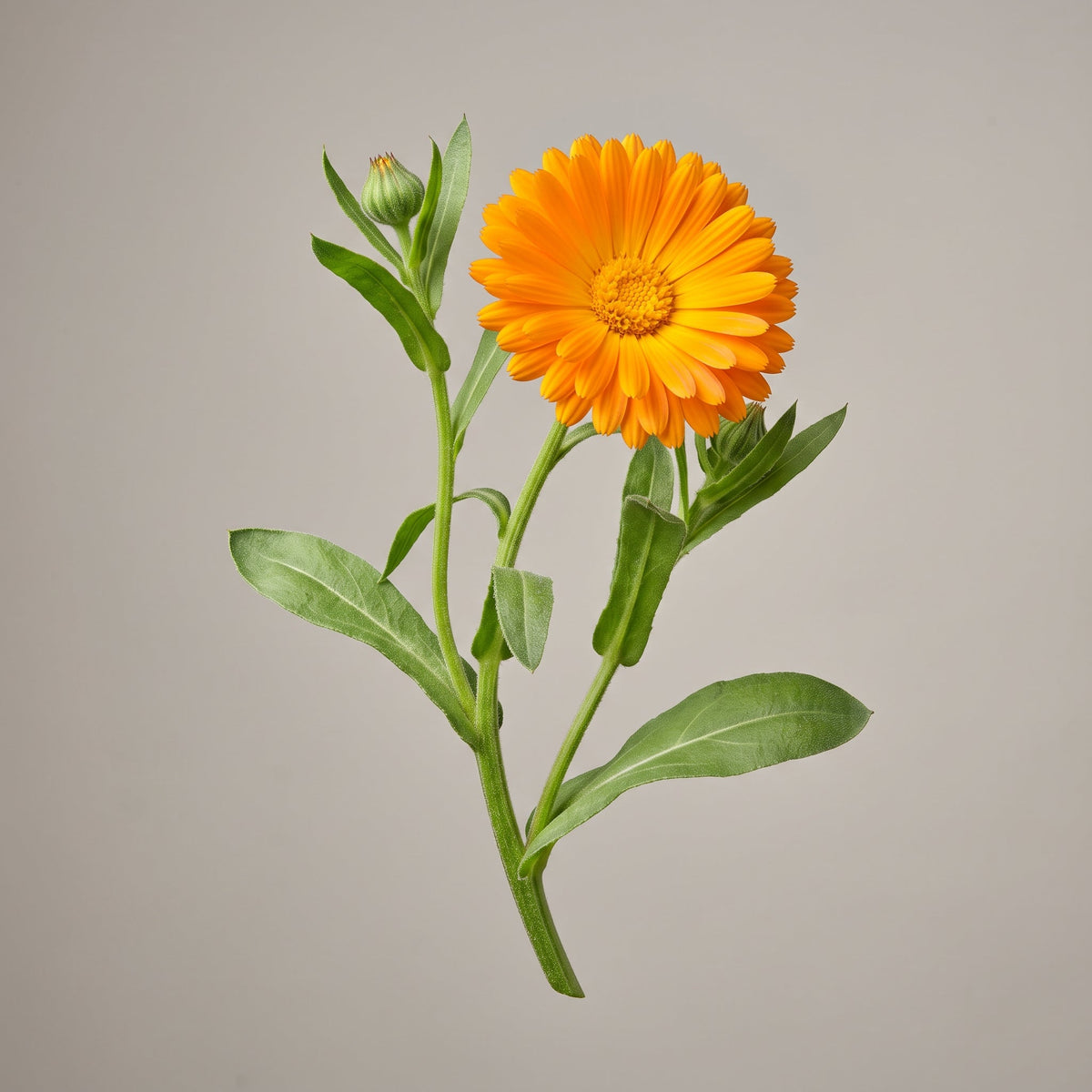
Marigold (Calendula officinalis) is one of the longest-used composite flowers in skincare. For industrial formulation, CONIUNCTA® supplies the Calendula Officinalis Flower Extract as a clear liquid from the flower, standardized via AVE technology and available in three carrier variants: Glycerin, Propylene Glycol and Pentylene Glycol. The extract is of conventional quality, suitable for vegan formulations, and carries the characteristic pale yellow hue of the flower. This article outlines the documented markers, the effect profile according to the CDS, and the practical differences between the carrier systems for formulators.
Narcissin as the Leading Marker of the Marigold Flower
The primary marker listed in the CDS is narcissin, chemically isorhamnetin-3-O-rutinoside, a flavonol glycoside of the marigold flower. For dried plant material, the data sheet cites a literature content of 0.3 to 0.8 percent (source: Ph. Eur. 10th / ESCOP). In the final product, the indicative range is 74 to 252 µg/mL. This estimate is derived from the dry material content, the DER of 1:10 of the extract fraction, and an extraction efficiency of 70 to 90 percent.
In addition to narcissin, the CDS lists faradiol esters as a further named compound, though without a quantitative figure (a pure effect description). For cosmetic application, the data sheet describes the faradiol esters as "soothing, anti-inflammatory, mild antimicrobial," and in the food context as "nutritional antioxidant, traditional dietary ingredient." The basis for all claims is the phytochemical profile and published literature.
Documented Effect Profile According to CDS
The CDS lists the following documented effects for the Marigold Extract: anti-ageing, balancing, anti-inflammatory, moisture-promoting, pore-refining and skin-plumping. TRPV1 and COX-2 (cosmetics) as well as metabolic health and the reduction of oxidative stress (food) are named as cosmetic and food targets.
Important for compliance: These statements originate from the phytochemical profile and the literature. The CDS explicitly notes that claims require independent substantiation in accordance with Regulation (EC) No. 655/2013. Final cosmetic claims therefore remain the responsibility of the party placing the product on the market. As a raw material manufacturer, CONIUNCTA® provides the documented profile without guaranteeing efficacy in the finished product.
Three Carrier Variants Compared
The extract is offered in three standardization media, each with an extract fraction of approximately 30 percent and water-based extraction (purified water):
- Glycerin: INCI Glycerin, Calendula Officinalis Flower Extract. Glycerin (anhydrous, ≥ 99.5 percent) makes up around 70 percent of the final product. This variant is additionally suitable for food applications.
- Propylene Glycol: INCI Aqua (Water), Propylene Glycol, Calendula Officinalis Flower Extract. Composition approx. 40 percent water, approx. 30 percent extract, approx. 30 percent propylene glycol.
- Pentylene Glycol: INCI Aqua (Water), Pentylene Glycol, Calendula Officinalis Flower Extract. Here, pentylene glycol serves as the standardization medium in a pentylene glycol/water blend.
All three variants are, according to the CDS, suitable for cosmetic applications (Regulation EC No. 1223/2009). The glycerin variant is designated for food applications. An overview of the aqueous-glycerin systems can be found in our Glycerin Extracts collection, with further botanical raw materials in the classic plant extracts.
Usage Concentration and Application Fields
For cosmetic formulations, the TDS names a recommended usage concentration of 2 to 5 percent; the CDS at-a-glance table additionally lists a use level of 1 to 3 percent. For functional foods and beverages, the CDS states 0.5 to 2 percent. The extract is suitable as a pale yellow, clear liquid for water-based and hydro-glycerin systems. Specific formulation and dosage questions within these frameworks are individually addressed by our technical team.
According to the CDS, the extract is free of fragrance allergens per Annex III of Regulation (EC) No. 1223/2009 (individual labeling obligations still apply) and suitable for vegan formulations. Note the manufacturer's advisory that temperature-dependent color changes, cloudiness or precipitation may occur during storage; filtration is possible in such cases and has no effect on quality.
Data, Safety and Sourcing
The SDS classifies the Marigold Extract as not subject to classification under Regulation (EC) No. 1272/2008: no hazard pictograms, no signal words, not classified as dangerous goods under ADR/RID, IMDG or IATA. The storage class per TRGS 510 is Class 12 (non-flammable liquids). Shelf life is 24 months in the original sealed container under dry storage between 10 and 30 °C. pH, relative density and refractive index are batch-specific and should be taken from the respective CoA; as a reference, the product specification states a density of 1.03 to 1.06.
We provide the complete data sheets (TDS, SDS, CDS) as well as batch-specific certificates of analysis via our technical documentation. Background on the gentle extraction process is explained on our AVE technology page. For sampling and project-specific consultation: view Marigold Extract in the CONIUNCTA® shop.
CONIUNCTA® - raw materials, data and services for future-ready formulations.


