


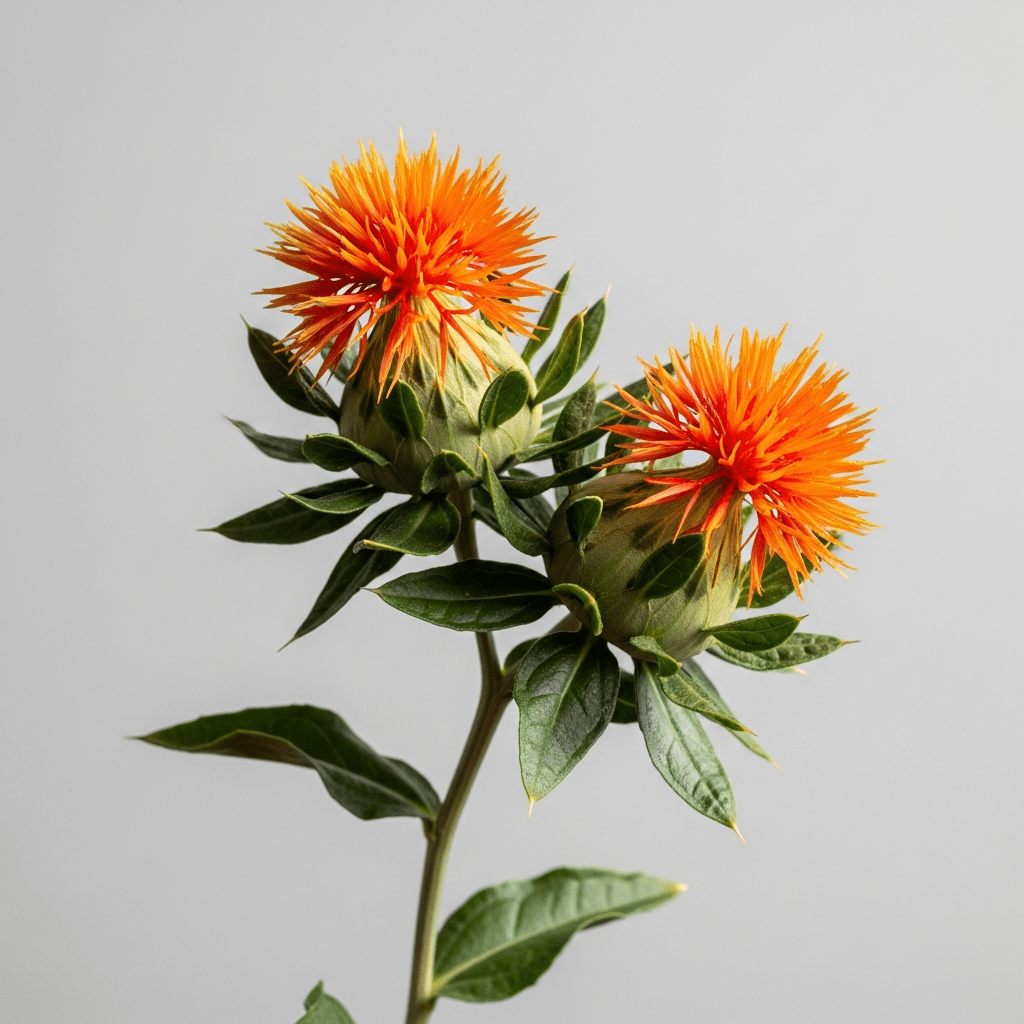
Safflower Extract (INCI: Carthamus Tinctorius (Safflower) Flower Extract) is obtained from the blossom of the safflower plant and is available at CONIUNCTA® as a clear liquid in three glycolic carrier variants: Pentylene Glycol, Propylene Glycol and Glycerin. As a characteristic key marker, Hydroxysafflower Yellow A (HSYA) is documented in the data sheet, a representative of the chalcones. For formulators in the cosmetics and food industry, this flower extract thus offers a defined marker profile combined with a flexible choice of carrier.
Safflower: the safflower plant as the source material
Safflower is the English name for Carthamus Tinctorius. In international trade, buyers encounter numerous language variants of the same raw material, such as "estratto di cartamo" in Italian or "concentrado de cártamo" in Spanish. Botanically, it is always the same species, whose blossoms form the plant part used for the extract. This very blossom is identified as the botanical origin in the CDS and in all three TDS (Flower Extract), of plant origin and suitable for vegan formulations.
For sourcing purposes, clear identification is important: those searching for "safflower", "safflower extract" or related terms will find at CONIUNCTA® a standardized flower extract with a documented marker profile and defined composition.
Hydroxysafflower Yellow A (HSYA) as documented key marker
The primary marker listed in the data sheet is Hydroxysafflower Yellow A (HSYA), assigned to the chalcone compound class. The literature content in the dried plant is stated as 0.3 to 1.5%; the indicative range in the product is 74 to 473 µg/mL. This range is derived from the content in the dried material, a drug-to-extract ratio of 1:10 in the extract fraction, and an extraction efficiency of 70 to 90%. The Chinese Pharmacopoeia (Ph. Chin.) as well as Yue et al. 2013 are documented as data sources on a review-level literature basis.
As a further documented compound, the CDS lists carthamin, the red pigment of the blossom, at 0.1 to 0.5%. This component contributes to the characteristic color of the extract, which is specified in the product as amber to light brown.
Documented effects and claim areas
For HSYA, the data sheet states "Skin conditioning, antioxidant" in the cosmetic context. In the food sector, HSYA is documented as "Nutritional antioxidant, traditional dietary ingredient". As supported cosmetic claim areas, the CDS lists Balancing, Elasticity support and Pro-age. Each is based on the phytochemical profile or published literature respectively.
We expressly point out that these claim areas require independent substantiation in accordance with Regulation (EU) No. 655/2013. The target areas named in the CDS are "General skin health" for cosmetics and "Metabolic health, oxidative stress reduction" for food use. Marketing terms such as "balancing" or "elasticity" serve as thematic orientation and do not replace regulatory substantiation by the formulator.
Comparison of three carrier variants
Safflower Extract is available in three water-based extracted, glycolically standardized preparations. The extract content is approximately 30% across all variants:
- Glycerin variant (INCI: Glycerin, Carthamus Tinctorius (Safflower) Flower Extract): water-based extraction, standardized in anhydrous glycerin (≥ 99.5%), composition approx. 70% glycerin and 30% extract fraction. According to the CDS, this variant is suitable for food use.
- Propylene Glycol variant (INCI: Aqua, Propylene Glycol, Carthamus Tinctorius (Safflower) Flower Extract): composition approx. 40% water, 30% extract and 30% propylene glycol.
- Pentylene Glycol variant (INCI: Aqua, Pentylene Glycol, Carthamus Tinctorius (Safflower) Flower Extract): aqueous-glycolic preparation with pentylene glycol as the standardization medium.
All variants are suitable for cosmetic applications in accordance with Regulation (EC) No. 1223/2009 and are free of individually declarable fragrance allergens under Annex III. For an overview of water-soluble systems, take a look at our glycerin extracts as well as the other classic plant extracts.
Usage concentration, processing and storage
The recommended usage concentration for cosmetic applications stated in the TDS and CDS is 2 to 5%; the CDS "At a Glance" table additionally names a range of 1 to 3%. For functional foods and beverages, 0.5 to 2% is documented. The density of the product is stated as 1.03 to 1.06.
Shelf life is 24 months when stored dry between 10 and 30°C in the original sealed container. The SDS lists the extract as not classified in accordance with Regulation (EC) No. 1272/2008; it is not a dangerous good under ADR/RID, IMDG or IATA and is not a PBT/vPvB substance. According to the disclaimer, color changes may occur depending on storage and temperature; in case of turbidity or precipitation, filtration is possible without affecting quality.
Frequently asked question: What does safflower mean and what is contained in Safflower Extract?
Safflower is the English name for Carthamus Tinctorius. CONIUNCTA®'s Safflower Extract is a water-based flower extract with the documented key marker Hydroxysafflower Yellow A (HSYA, a chalcone) and the red pigment carthamin. It is available in the carrier systems Pentylene Glycol, Propylene Glycol and Glycerin, is suitable for vegan formulations, and in the glycerin variant is also documented for food use.
Documentation and sourcing for B2B customers
We provide complete technical documentation for each carrier variant. TDS, SDS and CDS as well as batch-specific certificates of analysis are available to registered customers via our technical documentation. Background on our production process is explained on the page about AVE technology. You can view the Safflower Extract in the CONIUNCTA® shop directly online; for samples and project-related documents, reach us at info@coniuncta.com or by phone at +49 911 47715370.
CONIUNCTA® – Raw materials, data and services for future-ready formulations.


